Showing posts with label wooly bear. Show all posts

Monday, September 28, 2026

Folklore or Fact

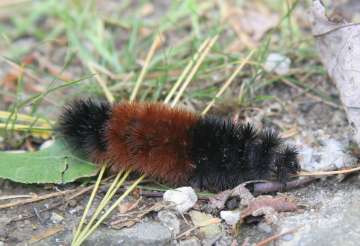
Well, if you believe old-time folklore, this woolly bear caterpillar’s wide rusty-brown band is indicating we’re gonna have mild winter -


This dude was crossing the walking trail in front of me this morning. I’m guessing looking for a cozy spot to hibernate for the upcoming winter.

Not to be a spoil-sport or anything, and my apologies for being the “bear”er (see what I did there) of bad news but woolly bear caterpillars cannot actually predict the weather, DUH! Rather their distinct coloring reflects their age, diet and the number of molts rather than the severity of  the upcoming weather.

Monday, October 16, 2023

Woolly Bear & Old Man Winter

Folklore, which goes back to Colonial times, says the upcoming winter can be predicted by the stripes on the Woolly Bear caterpillar.  

According to the legend, the longer the woolly bear’s black bands, the more severe the winter will be–longer, colder and snowier. On the flip side, the wider the middle brown band is, the milder the upcoming winter will be. 

In addition, the position of the longest dark band is said to indicate which part of winter will be coldest and hardest. So, if the head end is dark, then the beginning of winter will be worse. If the opposite end is dark, the end of winter will be colder.

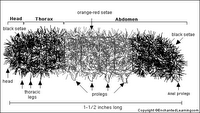
According to the folklore, the 13 segments of the caterpillar’s body correspond to the 13 weeks of winter. And the "woolier" the coat, the colder the winter.

The caterpillar’s coloring is thought to be based on its age, how long it’s been feeding and its species. In North America, there are over 200 species.

I took the below pics the other day on my walk.  Seems, based on these dudes anyway, that we're in for a milder winter around here, if you believe in the folklore.  We'll have to wait and see what Old Man Winter delivers...


Saturday, April 04, 2015

Spring Wooly Bear Sighting


Happened upon this Wooly Bear caterpillar this afternoon as I made my way out to feed and water the chickens and rabbits.

Again, nice to see some color outside, as well as sights of life after the long cold Winter.

Thursday, October 18, 2012

A Mild Winter Ahead...Maybe?

 
Came across this Woolly Bear Caterpillar on my way out to feed the animals.  Although, not the first one I've seen this year, it is the first one I've seen this fall.  What struck me about this particular dude is that he was mostly brown.  In years past I've see some that are mostly black or the two colors are more proportionate but not this fella.
 
As you may know Woolly Bears are known for predicting winter weather, which made the Woolly Bear one of the most recognizable caterpillars in North America.
 
So, what is this dude predicting for this upcoming winter?!?!
 
Well, according to The Farmer's Almanac -
 
According to legend, the wider that middle brown section is (i.e., the more brown segments there are), the milder the coming winter will be. Conversely, a narrow brown band is said to predict a harsh winter.
 
MILD!!
 
Certainly hope this is true but only time will tell.

Sunday, October 12, 2008

The Winter Predictor Worm

Here is a picture of the Wooly Bear caterpillars that Emilie has caught, so far, this fall. Each time she finds one in the oven it goes. Oh, don't be silly, not a real over - heaven forbid! She has one of them there Little Tyke, plastic, kitchenette thingy that has been relegated to the pool area. The oven unit is on top, has a clear door and makes for a perfect critters holder...

Wooly Bear Fun Facts and folklore:
Woolly worms have very tiny eyes and a limited range of sight. They pass through up to 6 larval stages before reaching the stage most see in the fall; during which the color and size of its bands on the 13 body segments may change. It is those 13 bands that folklorists use to help predict the weather. According to folklore:
  • The amount of black in the fall varies proportionately with the severity of the upcoming winter.
  • The longer the black bands, the longer, colder, snowier and more severe the winter will be.
  • And the position of the bands indicates which parts of winter will be the coldest.
  • If the head is dark, the winter starts out severe.
  • If the tail is dark, the end will be cold.
  • Since the Woolly Bear has 13 body segments, folklorists believe that each segment corresponds to one of the 13 weeks of winter. So reading each band could conceivably forecast each week of the winter.
  • Also known as the Fuzzy Bear, Hedgehog Caterpillar, Wooly Worm and Wooly Bear (approved name of the Entomological Society of America).
Other signs include thicker coats meaning colder winters and if they seem to be traveling south, they are trying to escape the cold conditions of the north. If they are traveling north, however, it indicates a milder winter.

Through the years, research has shown us that the Woolly Bear caterpillar’s coloring is actually based on how long the caterpillar has been feeding, its age and, of course, the species. The better the growing season, the bigger it will grow and this results in a narrower red-orange band in its middle. So, the width of the banding is really an indicator of the current or past season’s growth, rather than an indicator of the severity of the upcoming winter. And as these caterpillars may molt as many as 6 times before reaching adult size and the colors will change with each molt, they become less black and more reddish.

Friday, May 18, 2007

Woolly-booger

I came across this word and its definition today while browsing the Internet. I found it ironic and interesting due to my recent post on the Isabella Tiger Moth.

Double-Tongued Dictionary definition of 'woolly-booger -

woolly-booger n. (also woolly-bugger) 1. (colloquial) the larval-stage insect known as the woolly worm or woolly bear; a fishing fly that resembles such an insect. 2. (in the American Southwest, slang) an extraordinary example of a thing. 3. (in Oklahoma and Louisiana, slang) provisions intended to be overlooked in legislation.

Who would have thunk?

Sunday, May 13, 2007

The Isabella Tiger Moth

Emilie caught a Wooly Bear caterpillar about 3 or 4 weeks ago that she kept in her insect bug cage. She would hold it and talk to it all the time. Approximately 2 - 2.5 weeks ago, and much to our surprise, it spun a cocoon (pupated).

Emilie called me at work on Friday, all excited, to tell me the cocoon has hatched. It emerged as the stunning Isabella Tiger Moth, which is a member of the Arctiidae family. There are many species of this moth, ours is the one pictured below - notice the handsome finger perch too. On Saturday we let it go and even though it was confined to a small cage, it surprised us as how far it was able to fly on it's maiden flight.


SFrye732_Blog archive - December 01, 2006 Wooly Bear posting

Friday, December 01, 2006

Woolly Bear Caterpillar


I was out in the yard on Thanksgiving morning cleaning out the chicken coop - well it's not really a coop just yet, more like a pen but it needed cleaning regardless so let's not split hairs here OK? Anyway, as I was pitch-forking the bedding out I came across a nice fat Woolly Bear caterpillar. We'd seen a number of them as the fall approached but never this late in the year. I guess the mild New England weather has kept these dudes, as well as other insects and critters, on the move and from going into a full hibernation.

I scooped this dude up and placed him in my jacket pocket for safe keeping and not to lose him - I didn't squish him either AND I actually remembered he was there too! Anyway, as I typically do, this dude was going to Emilie. Let me tell you Emilie eye's lit up when she saw him and screamed, "a woolly bear". She was in her glory with this critter. He was relegated to a Winnie the Pooh dixie cup for several days, which was it's safe haven from when Emilie wasn't holding him and playing with and making him do tricks, stunts etc. She came to us with the boot from one of her dolls - a 'hootchy mama' boot if you will. You know the long, knee high black boots...anyway guess where the woolly bear was 'stuck'?!?! Between you and me he wasn't stuck, he simply found a safe place to stay hidden. Eventually he made his way out and Emilie was once again in her glory. We let him go just the other day, much to his relief and looking forward to finding a safe place to winter.

Woolly bears caterpillars were thought to predict how a coming winter was going to be. According to legend, the wider that middle brown section is (i.e., the more brown segments there are), the milder the coming winter will be. Conversely, a narrow brown band is said to predict a harsh winter. But most scientists discount the folklore of woolly bear predictions as just that, folklore.