Just the other day, out of the blue, Emilie asked if she could have a guinea pig someday. The very next day there was a posting on the bulletin board at work, "Guinea Pigs for Sale". How could I refuse with a coincidence like that?! It's karma I tell yeah. Needless to say Emilie got her pet guinea pig and I need my head examined...
Wednesday, September 13, 2006
Meet Riley
Da Plane

It was a beautiful day as you can see and I was in the backyard vacuuming my pool, in the process of closing it up for the winter, when JoAnne says, "Emie look". Low and behold this incredible sight!
Here it is Sunday September 10th, one day away from the five year anniversary of 9/11 and this bird is flying over our area, so you can just image what we're thinking. To boot, which only fueled our imagination, the night before there was a 'Breaking News Story' on the local news about a security scare near the LNG Facility in Everett, MA about a Suspicious Truck Found Nearby.
Now I bet you're wondering how I got these pictures and if I walk around with a camera in my back pocket. Well, the answer is that this was the second pass for this plane, which came about 20 minutes after the first. This time I just happened to be in the kitchen, which was where the camera was too. Also, I will never tell or admit if I carry a camera in my back pocket.
Come to find out this plane was a part of the New England Patriots season opening pre-game festivities - mystery solved. The stadium is where the Pat's play is not too far from where we live.
Oh, and the Pat's won 19-17 over the Bills with a safety...GO PATS GO!
Friday, September 08, 2006
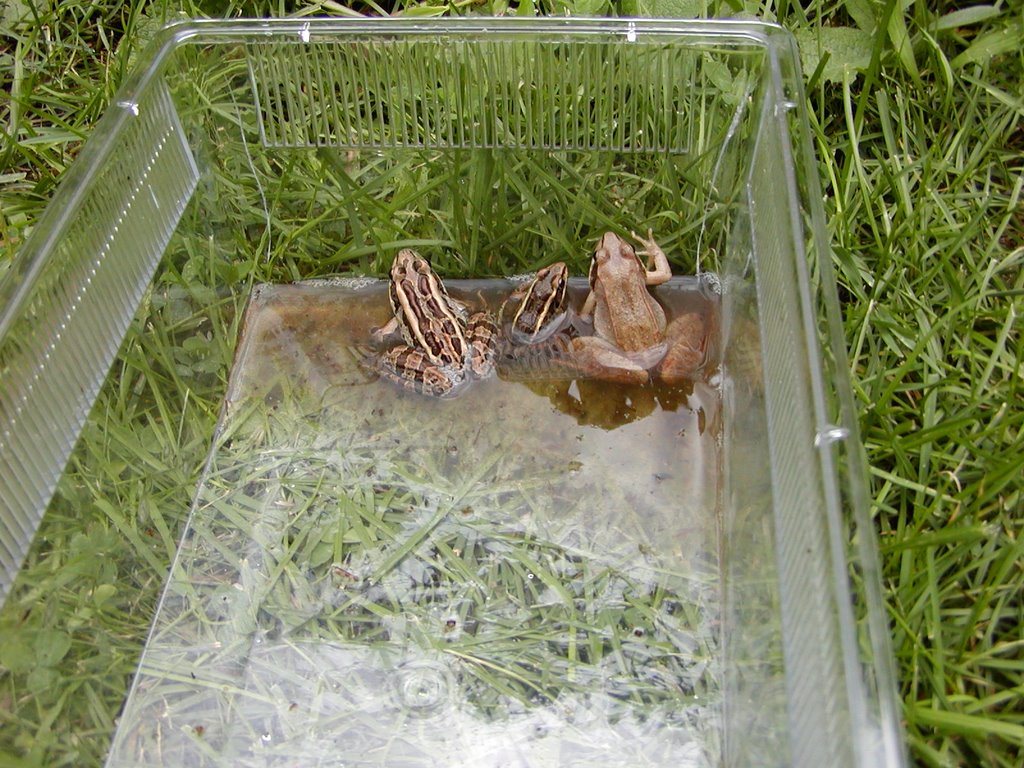
Mr. Pickerel Frog
The pickerel frog is a medium sized frog being about 3 inches in body length with smooth-skin. Adults are tan or brown (never green) with four to five pairs of squarish brown spots. They have complete light gold dorsolateral ridges down the back. The belly is plain white. There is a distinctive yellowish wash in the groin areas and the thighs. There are brown tiger stripes on the hind legs.
Pickerel Frogs are similar to Northern Leopard Frogs in general size and appearance. Unlike leopard frogs, pickerel frogs are always brown (leopard frogs, except plains leopards, may be green or brown), have square spots arranged in pairs on the back, and a yellowish wash on the thighs (all leopard frogs usually have a greenish wash).
Pickerel frogs breed in spring (late April, May, and June). The males call is a deep snore. It is shorter and higher pitched than the northern leopard frog’s call and is usually not followed by a chuckle as in leopard frogs. They call from the shore or from underwater in shallow portions of the wetland. Females lay 2,000 to 3,000 eggs. The tadpoles transform in two or three months.
Side-by-side comparison of a Pickerel Frog vs a Leopard Frog
Carrot, Egg or Coffee Bean?
A young woman went to her mother and told her about her life and how things were so hard for her. She did not know how she was going to make it and wanted to give up. She was tired of fighting and struggling. It seemed as one problem was solved, a new one arose. Her mother took her to the kitchen. She filled three pots with water and placed each on a high fire. Soon the pots came to boil. In the first she placed carrots, in the second she placed eggs, and in the last she placed ground coffee beans. She let them sit and boil, without saying a word. In about twenty minutes she turned off the burners. She fished the carrots out and placed them in a bowl. She pulled the eggs out and placed them in a bowl. Then she ladled the coffee out and placed it in a bowl.
Turning to her daughter, she asks, "Tell me what you see.""Carrots, eggs, and coffee," she replied. Her mother brought her closer and asked her to feel the carrots. She did and noted that they were soft. The mother then asked the daughter to take an egg and break it. After pulling off the shell, she observed the hard boiled egg. Finally, the mother asked the daughter to sip the coffee. The daughter smiled as she tasted its rich aroma. The daughter then asked, "What does it mean, mother?"
Her mother explained that each of these objects had faced the same adversity: boiling water. Each reacted differently. The carrot went in strong, hard, and unrelenting. However, after being subjected to the boiling water, it softened and became weak. The egg had been fragile. Its thin outer shell had protected its liquid interior, but after sitting through the boiling water, its inside became hardened. The ground coffee beans were unique, however. After they were in the boiling water, they had changed the water.
"Which are you?" She asked her daughter. "When adversity knocks on your door, how do you respond? Are you a carrot, an egg or a coffee bean?
"Think of this: Which am I? Am I the carrot that seems strong, but with pain and adversity do I wilt and become soft and lose my strength? Am I the egg that starts with a malleable heart, but changes with the heat? Did I have a fluid spirit, but after a death, a break-up, a financial hardship or some other trial, have I become hardened and stiff? Does my shell look the same, but on the inside am I bitter and tough with a stiff spirit and hardened heart? Or am I like the coffee bean? The bean actually changes the hot water, the very circumstance that brings the pain. When the water gets hot, it releases the fragrance and flavor. If you are like the bean, when things are at their worst, you get better and change the situation around you. When the hour is the darkest and trials are their greatest, do you elevate yourself to another level? How do you handle adversity?
Are you a carrot, an egg or a coffee bean?
Wednesday, September 06, 2006
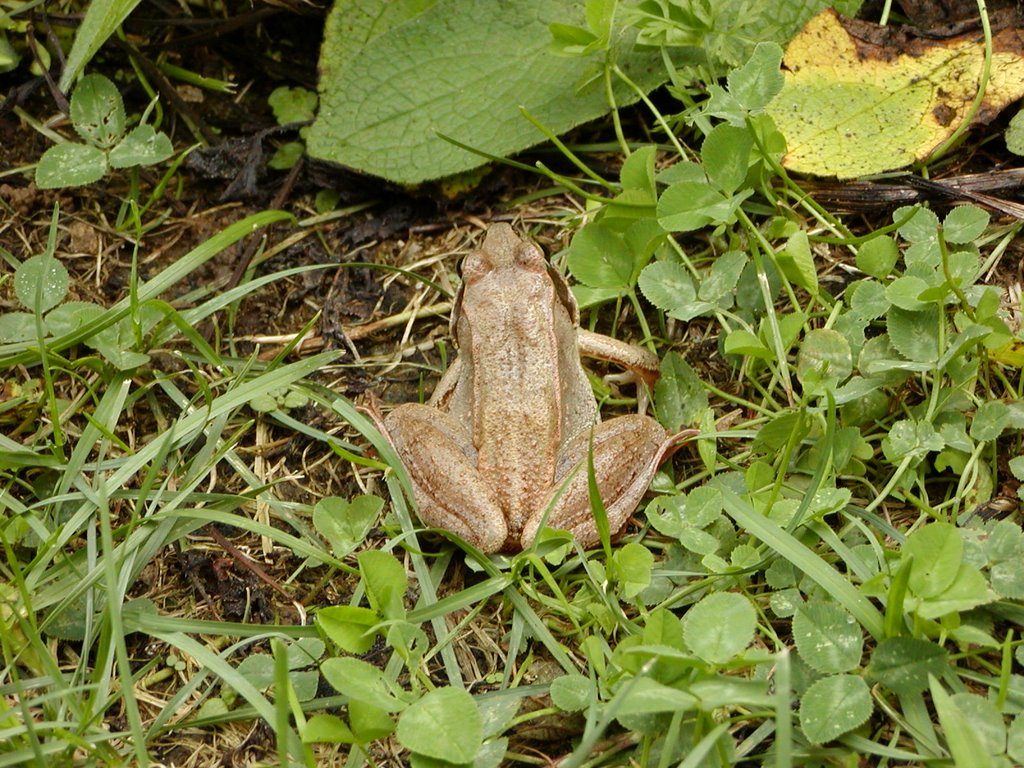
Mr. Wood Frog
Here is a picture of a Wood frog we caught at my dads house. As we usually do we took him to our house and enjoyed him for a few days before releasing. This one was quite large, actually one of the largest I've seen, and about as big as they get. My dads house abuts wetlands, as does our so this guy will do just fine in his new surrounds. As a matter of fact it's been 3 weeks since we let him go and he's still out there. I've come across him several times, which is what we were hoping for.
The Wood Frog is most easily recognized by its "robber mask." This black band stretches past both eyes to the eardrums. Wood Frogs also have dorsolateral ridges, two raised lines running down their back and a white belly. Because Wood Frogs spend a lot of time on land, the toes on their front legs are not fully webbed. You can tell males from females by their swollen thumbs
Wood Frogs are very active, and can jump farther than most frogs. To hunt, they can ambush prey, like most frogs. Wood Frogs eat beetles, flies, caterpillars, and other insects; and also spiders, other arthropds, slugs, snails, and worms.
Predators of Wood Frog eggs and tadpoles include leeches, fish, and aquatic insects. Adults are eaten by raccoons, owls, and other animals
When winter's snow is all but gone, leaving ponds and ditches brimming with melt water, wood frogs emerge from hibernation and get right to the business of breeding. Wood frogs (Rana sylvatica) are among the first amphibians to breed each year, starting as early as mid-April.
Note: Boreal Chorus Frogs, Spring Peepers, and the Blue-Spotted Salamander, are a few examples of animals that also breed right after the snow melts.
Wood frogs are truly remarkable little creatures. They are the most widely distributed amphibian in North America, even reaching beyond the Arctic circle! They can mature from egg to transformed frog in as little as 45 days. But perhaps their greatest feat is the unique way in which they spend winter... frozen solid!
Wood frogs are members of a rather exclusive club of vertebrate (back-boned) animals that overwinter on dry land and survive the freezing of their body tissues. World-wide there are only a few species of vertebrates that can tolerate freezing. (Baby painted turtles are the "highest" vertebrates known that can tolerate tissue freezing). Though this feat is "no big deal" to many plants and invertebrates (lots of insects do it), it is a neat trick that enables wood frogs to inhabit many northern environments and frees them from dependence on permanent bodies of water.
The Swallowtail Chrysalis is just one example of an insect that winters in it's pupal or chrysalis stage. Some insects overwinter, and deal with the cold as adults, some as pupae, some as eggs and even some as caterpillars.
Lawn Mowing Machine
As you can see the window shattered into a million pieces. There was glass everywhere, both, inside and out and actually we're still finding pieces inside the truck today, which is almost a month later.
The neighbor was cutting an area where they typically park trucks, so there wasn't much grass left but rather tire ruts and rocks and weeds. Well in his quest to get at and cut the weeds he mowed over a few rocks in the process. The poor mower was taking a beating and we were commenting on his lawn cutting abilities just before this happened, joking about needing to duck. It wasn't two minutes after that when JoAnne noticed what had happened and she wasn't too happy.
Naturally, this particular Ford Explorer model has a 'special' rear window - Murphy's Law right. You'll notice in the picture the warped section in red, just below the wiper blade. This is part of the window and is replaced with the new window as one whole piece. However, this piece does not come painted, it is just primed. Therefore, it needs to be painted to match the color of the vehicle. The one place we took it to for an estimate wants to paint the entire rear door to ensure the colors match - makes sense. However, our insurance company will not pay to paint the entire door - oh they will if we file an official claim, which means paying the deductible. They will, however, as a part of the glass replacement, pay to have that one strip painted at no cost to us.
No matter how you look at it the entire process is a pain in the ass. OH and the replacement window already has some minor issues...
Tuesday, September 05, 2006
Sunday, September 03, 2006
Mr. Grey Tree Frog - UPDATE
We let him go yesterday. We worked on taking some pictures of him, so we placed him on a few different plants. All in all he was a good boy and let us pose him as we wanted.
When done taking pictures we placed him on one of our Autumn Joy Sedum plants - Can you find him in the picture below? You'll have to look hard, as he blends into these particular plants perfectly - he looks like one of the plants leaf.
We placed him on this plant, which had some flies and bees also visiting and gathering nectar from the flowers. We watched him for a few minutes and were amazed to see this little guy line up one of the flies, which was on another flower approximately 4 inches away, and leap. It happened so fast but the end result was the frog had caught himself a snack - a mouth full of fly!
Here is a picture of him sitting in the center of a Sun flower -
Hopefully he'll choose to stay in the area we placed him and continue his rein of insect control and that we'll meet up with him again.
Friday, September 01, 2006
Mark Twain
It's a good thing I don't use profanity, but if I did I would have to agree with Mr. Twain...
Thursday, August 31, 2006
New Honey
She is a Barred Rock pullet; approximately 6 months old. I bought her in the spring to add to our backyard poultry menagerie. She's a good little girl and when alone always singing. However, Lucy and Ethel (pictured below) do not like her and will not leave her alone. They are constantly after her to the point that she can not get any rest. When they are out together, she spends the entire time on her roost. It's gotten to the point now that we either put her out for a few hours before the others, or she goes to bed earlier - this way she has time to eat, drink, scratch and dig before she's driven to roost.
We got our first egg from her the other day, but because of the situation we've yet to receive more.
Actually, now that I think of it Lucy and Ethel are a couple O tough nuts. They let Emilie know in the spring who was boss - one of them chased her and peck the back of her leg. As you can imagine Emilie is not fearful of them. They have also taken a similar approach with JoAnne, which blows my mind because JoAnne tends to them most of the time. JoAnne's not as fearful of them as Emie and will try to give them a "what for" when they come at her but she needs to pay attention none-the-less.
The Barred Rock is one of the all time popular favorites and was developed in New England in the early 1800's by crossing Dominique's and Black Java's. Prolific layers of brown eggs, the hens are not discouraged by cold weather. Their solid plumpness and yellow skin make a beautiful heavy roasting fowl. The narrow, clean barring is desirable in appearance. Their bodies are long, broad, and deep with bred-in strength and vitality. These chickens are often called Plymouth Rocks, but this title correctly belongs to the entire breed, not just the barred variety. Whatever you call them, you can't beat them for steady, reliable chickens. Baby chicks are dark gray to black with some white patches on head and body.
Plant Identification Assistance Needed...
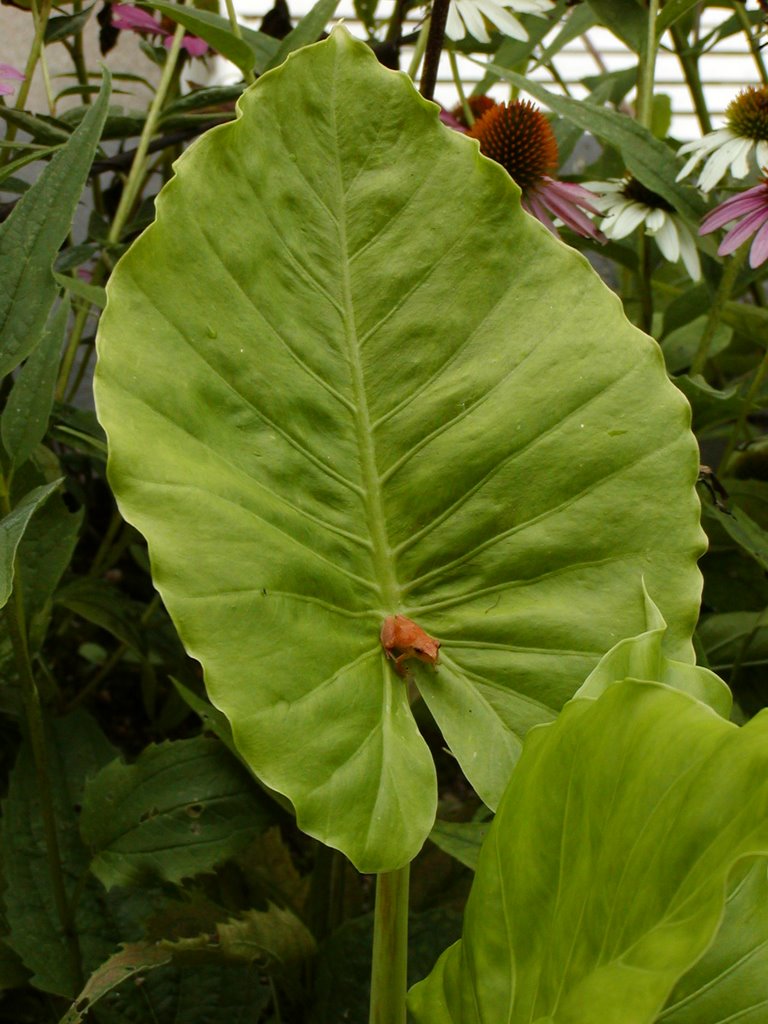
I need your assistance in identifying this plant! This plant was in the landscaping when we bought our house and we've been unable to figure out just what it is. We live in Massachusetts.
It grows similar to a tree - each plant on its own stem and gets approximately 6 feet tall. It seems to spread and create new plants from it's root system. The flowers are a violet and white with a very pleasant aroma. Each leaf is attached directly to the stem and get quite large.
This is an offshoot from where the majority of these plants reside - about 10 feet away, and on the smaller side, as compared to some of the older ones. The flowers on this plant have yet to open.
*** UPDATE, Wednesday September 6, 2006: Well, this plant has FINALLY been identified!! Many thanks to Roberta at UMass Extension. Not only did she identify this plant but her quick and prompt response was refreshing. Within less than 30 minutes of the email I sent her this morning I received her response and answer - amazing.
Too bad this type of response - common courtsey, isn't found more often. Paul Parent you SUCK!
It took me over seven years to identify this plant, so don't expect me to give you the answer here. Do some research, be resourceful, "be the ball" and if after all that you can't figure it out, let me know.
Mr. Grey Tree Frog
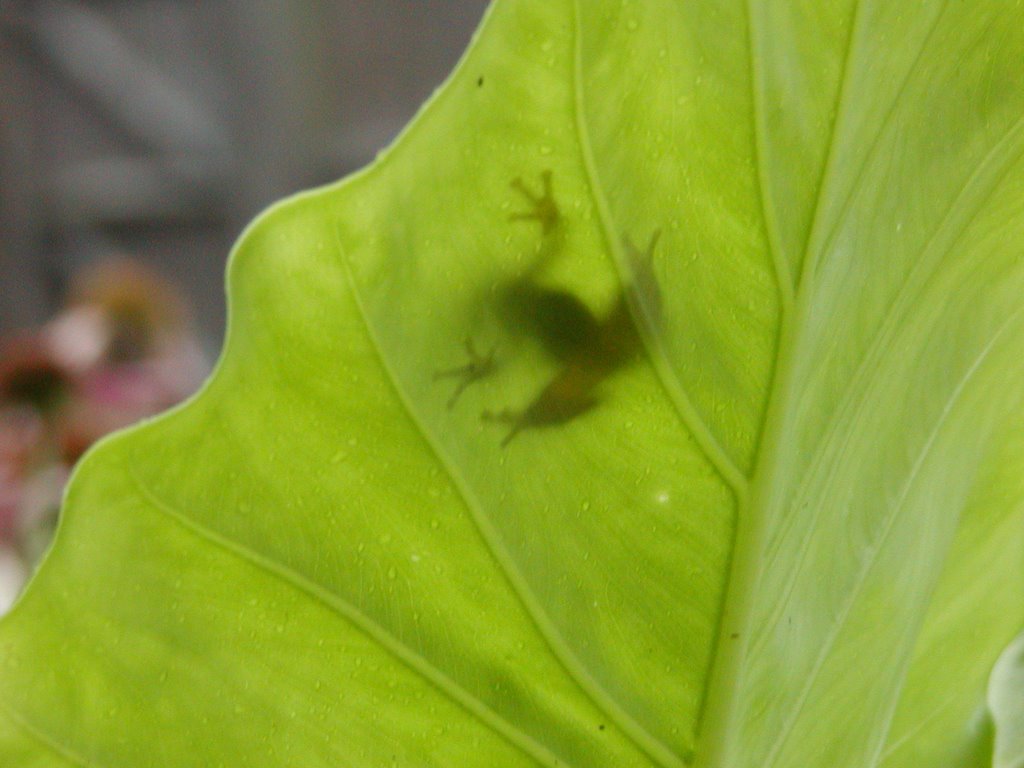
Well, not to be out done by the visiting Spring Peeper just the day before, this handsome fellow made an appearance last night. This is a Grey Tree Frog and I came across him hiding perfectly on my garden hose. The hose is grey and green, and so is the frog - camouflaged perfectly. Had I not seen him, he surely would have gotten hurt, even 'croaked', as I was in the process of unwinding the hose.
Emilie ran and got her critter bucket and as usual we brought him in the house. We caught him several bugs incase he got hungry and enjoyed watching him climb all over the sides of the critter bucket. These guys are similar to the Spring Peeper in that they both have large toe pads for gripping when climbing.

Growing up I don't recall ever seeing or catching Grey Tree frogs but I've come across them more and more lately. Last year we found a fairly large one hiding in the hole of a stockade fence post just beside our pool. We didn't bother him and he stayed there for days on end - I guess the eat'n was good there, after all we're always finding all types of insects floating in the pool.

The chameleon of the frog world.
They live wherever they find small ponds, roadside ditches and other pools of standing water. The best habitat is shallow water located close to mixed stands of willows, oaks and pines. The frogs also prefer lots of overhead vegetation, and fallen branches or extensive vegetation along the water’s edge. They often congregate in areas with an abundance of shrubs and vines.
During the day, gray tree frogs hide on or beneath rough tree bark, in hollow trees and on leaves. They tolerate high temperatures quite well, and they're most active during the summer, when humidity is high.
Their remarkable ability to climb or rest on vertical surfaces is the result of a mucous layer produced by toe pad cells. This mucous creates a sticky bond with the vertical surface that’s strong enough to support the frog’s weight.
This frog’s breeding season lasts from early April through July. Males begin calling at breeding sites when night air temperatures reach around 60 degrees. Their calls resemble musical, birdlike or buzzing trills, and the chorus attracts females to the site. The frogs then breed in water.
Afterwards, each female may produce between 700 and 3,800 eggs, and biologists have documented individual frogs producing multiple clutches in a single season. Eggs are light brown, and they measure barely 1/25-inch in diameter. After they are deposited, the eggs attach to floating vegetation in clumps of 30 to 40 eggs. They hatch in only four or five days, and the tadpoles completely metamorphose within two months. Young frogs typically stay near the breeding site for the remainder of summer.
Tuesday, August 29, 2006
Mr. Spring Peeper


One of the first true signs of spring in New England and nearby areas is the evening calling of the Spring Peepers
Spring Peepers live in wooded areas where there is water. Usually they are near marshes, ponds, streams, or vernal pools. Spring Peepers need the water to lay eggs. This is also where they mate. Spring Peepers are nocturnal, so they are most active at night.
Male peepers call the females at night in the spring. Each call is a high-pitched whistle, but many peepers’ together sounds like jingling bells. Females come to the calling males, and after mating, they lay eggs on underwater sticks and plants. Eggs hatch into tadpoles in about twelve days. Tadpoles will eat algae and tiny organisms in the water.
Tadpoles will change to adult Spring Peepers in a few weeks. Adults spend the rest of the year in the woods, coming out at night to look for food. Spring Peepers eat mostly small insects, such as beetles, ants, and flies, as well as spiders. They look for food on the forest floor or by climbing low shrubs. In the winter, Spring Peepers hibernate under logs or loose bark on trees. These small frogs can survive having most of their body frozen.
Spring Peepers have many predators. As eggs and tadpoles, they are eaten by fish, aquatic insects, turtles, and other creatures. As adults, they are preyed upon by snakes, Bullfrogs, birds, and a few mammals.
Friday, August 25, 2006
Bucket-O-Wrappers
Orb Weaver
The black and yellow argiope is also called banana spider, yellow garden spider, zipper spider, golden orb weaver and writing spider.
Orb weaver (Encyclopædia Britannica):
Any spider of the family Araneidae (Argiopidae or Epeiridae) of the order Araneida, a large and widely distributed group noted for their orb-shaped webs. More than 2,500 species are known.
In the eastern Unites States, Argiope species, especially A. aurantia, are more commonly known as writing spiders, due to the unique patterns that they build in their webs. In years past, it was sometimes called the "McKinley spider" because in the period before the election that brought McKinley to office someone claimed that the stabilimentum of one spider's web spelled out "McKinley."
Friday, August 18, 2006
Ecdysis
Once again on our walk the other day we came across yet another critter commonly found in Massachusetts. This is a Common Garter Snake and a unique one at that, which is why I chose to catch her. Garter sizes range up to 26" with some reaching 48" - this gal was about 14". I wanted to point out the uniqueness of this snake to Emilie. If you look closely at the picture you just might be able to see why this one is unique too - No, it's not the fantastic manicure of mine but thanks for noticing... I'll give you a clue; look at her eyes.Her eyes are a bluish-white. This is an indication that this snake has begun the shedding process (Ecdysis). Shedding is the process by which snakes periodically discard the outer portion of their skin. This activity is under hormonal control and associated with growth. Most snakes shed their skin 4-8 times per year. When this occurs the snake's vision is impaired - she can't see, which causes them to be rather unpredictable and sometimes aggressive and this girl was just that! She wanted a piece of me and gave it the ole college try but I watch Austin Stevens the Snakemaster on Animal Plant, so she had no chance. However, most individuals secrete a foul-smelling fluid from anal glands when alarmed and this gal did just that, YUK. I realized this and was careful just the same but inevitably when you handle a garter snake you're gonna get this 'stuff' on you, there's just almost no way around it.
Garter snakes occupy a variety of habitats including pond and stream edges, wetlands, forests, fields, rocky hillsides and residential areas. They are often observed as they bask on rocks, wood piles, stone walls, hedges and swimming pool decks. Although they feed on a variety of small animals, garter snakes' primary prey are earthworms and amphibians. Their saliva appears to be toxic to amphibians and other small animals and a bite may produce swelling or a burning rash in some people.
We checked her out then put her back where we found her and wished her well. Perhaps we'll see her again on another one of our walks only this time she'll have grown and be bigger. Until then we wish her well.
Foie Gras Ban
AND
I consider myself fortunate that I have not taken a fancy to this delicacy. For if I had, I wouldn't be able to travel to Chicago ever again...
Thursday, August 17, 2006
Yodeling Baloney
I not so sure now if it's an inability, or the pack-rat in him, or his lack of smell or his new fond love of science! Yeah, that's it, it's gotta be his new fond love of science, especially after what I've seen in there, YIKES!
In any event this Garfield cartoon says it all, and to boot our names were on it too - can you believe it? how odd. Apparently Jim Davis has caught wind of this too...
Wednesday, August 16, 2006
Tettix or Tzitzi
This is a picture of a cicada we caught the other night when we were out for a walk - please pay no attention to my dirty fingers. Man did he make a lot of racket trying to get out of the brush he was hiding in. I think I startled him as much as he startled me.These critters are not the quickest nor the most graceful of bugs and as a result he wasn't able to get out of the brush he was in and get away. Rather he got stuck and fell to the ground, where I grabbed him. We took a few pictures and checked him out - not the most attractive bug either, then let him go. It took a few seconds for him to get his wings and get going and once he did off he went buzzing away.
The word Cicada derives directly from the Latin "Cicada", in Greek they are called "Tettix" or "Tzitzi".
Cicadas are notorious singers. The song is a mating call produced by the males only. Male cicadas (and only males) have loud noisemakers called "tymbals". Each species has its own distinctive call and only attracts females of its own kind even though rather similar species may co-exist.
Cicadas are related to leafhoppers and spittlebugs, here are a just a few example links:
Scarlet & Blue Leafhopper
Potato Leafhopper
Two-lined Spittlebug
Spittlebug froth mass
Tuesday, August 15, 2006
aka "Uncle Tommy"
He told us that if you take clippings of these flowers and put them in a vase with water and add food coloring to the water, that this flower will change colors to that of the food coloring you added. As you can see from the two pictures below; a before and after, we gave this a try and IT WORKS!! All we had in the house was green food coloring but we plan on buying more and trying this with other colors too.
This plant is also known as Wild Carrot, which is a biennial and a member of the Parsley family, and normally grows three to four feet tall, but can grow almost five feet in the right conditions. Its flowers are white and sometimes pink. Being related to the carrot, it has a carrot-like root that even smells like a carrot.
There is a tiny purplish-black floweret in the center of the otherwise white flower? The black floweret is sterile and will not produce seed. It is not known why nature put it there, perhaps to attract pollinators.
In memory of JoAnne's uncle, we now refer to this flower as "Uncle Tommy". When visiting us one day Tommy had mentioned that he really liked this flower and that's all it took to have it named after him - at least in our little corner of the world. Just ask Emilie what this flower is called and she'll tell you, "Uncle Tommy"! He is certainly missed by all...
Monday, August 14, 2006
Prophet or Seer (Fortune Teller)

The summer has been an exciting one with all the critters I've encountered. Some are typical and I see them from year to year but many have been some that I have not seen in quite some time. A perfect example would be the lovely lady perched on the gorgeous Dinner Plate Dahlia in the picture above - a Praying Mantis or praying mantid. By the way, that's one of many Dahlia plants that we have planted in our yard this year - many different colors and styles too.
***Note: The word mantis derives from the Greek word Mantes for prophet or fortune teller
Actually, I just lied. I now recall finding a Praying Mantis floating in my pool last year but that doesn't count. This one I found outside a local hockey rink on a Milkweed plant, where my son was practicing. I was looking for another Monarch caterpillar - swing and a miss on that search but I was lucky enough to have found something just as interesting!
I brought her home for Emilie to see and enjoy and experience. We caught her some moths that night and she wasted no time in catching and devouring them. This alone is worth the price of admission - it's amazing, the entire process of watching her catch her meal to how she holds it to how she eats it. Here is an excerpt I came across detailing their eating style:
"They wait unmoving and are almost invisible on a leaf or a stem, ready to catch any insect that passes. When potential prey comes close enough, the mantis thrusts its pincher-like forelegs forward to catch it. The prey probably won't escape because the forelegs are so strong and armed with overlapping spines. The mantid bites the neck of its prey to paralyze it and begins to devour it. The mantis almost always starts eating the insect while it's still alive, and almost always starts eating from the insect's neck. This way, the mantis makes sure that the insect's struggle stops quickly."
We kept and enjoyed her for a few days. Yesterday was release day, so we took her to one of our many flower gardens and placed her on the Dahlia - Ok, Ok so you busted me. Yes, we staged the picture. We wanted a nice picture and thought the contrasting colors would be ideal and I must admit we hit this one outta the park! We went back down a few hours later and she was still there, although she'd moved off the flower and was camouflaged perfectly, just waiting for a meal to cross her path!
Additional Information
Friday, August 11, 2006
Oink, Oink

We took a drive today to go visit a friend of mine. We don't get to see him too often as he lives over an hours drive from where we live. It's a drive that has no direct route and usually has traffic somewhere along the way. It was a beautiful day and had been close to two months since we've seen him last so off we went JoAnne, Emilie and I.
Tim's his name and farming's his game. He lives on over 80 acres, raises animals, and grows flowers and vegetables in his greenhouse year around to make ends meet. He an old timer of sorts and lives as such. He doesn't have too much but will give you the shirt off his back and an incredible wealth of knowledge. His managerie today consists of; goats, pigs, cows, chickens, ducks, geese and rabbits - not too many of each but just enough to keep him busy full time.
Interesting enough, we met over 25 years ago when he responded to an ad I place in The WantAd - a local, weekly black and white, newspaper type magazine that lists pretty much anything you can think of from animals to furniture to autos and more... but I digress. Anyway, he responded to an ad I placed for a pygmy cross goat I was selling. Back then I was still a 'ute' and living at home with my folks and we've been very good friends ever since. I consider myself extremely lucky, fortunate to have come to know him and consider myself a better person because of him.
*** Quiz Time *** - The term 'Utes" comes from what movie? Come on now! Do we need a hint? Oh, alright then here's a clue, a name and that's all I'm gonna give you...'Vincent Gambini'
It's always exciting to visit, the time usually passes by too fast and before you know it it's time to head home. There is always something new and exciting that he's picked up and this trip was no different. As alway Emilie is thrilled by all the critters and usually bonds with one of them. On this visit she took a fancy to a potbellied pig. She's usually roams free with others potbellies but today she was caged, as she's pregnant and expecting soon. Emilie was having a ball feeding here grass, weeds and bread - she definetly made another friend - see her picture above.
The surprise this visit was an Eastern Box Turtle that he'd recused crossing the road. Now I've lived in New England all my live and I have NEVER found a box turtle in these parts, darn it! Anyway, she was a beautiful girl and actually the biggest one I've ever seen. We took a bunch of pictures, some will be used to catalog her, as the markings on Box Turtle shells are like finger prints, each indivdual and unique. In essence she's been cataloged and will now be released back in the area she was found.
Here is a picture of her and a URL, which is loaded with great information and links about Box Turtles:
Thursday, August 10, 2006
Who Goes There?
Last year I installed an old metal farm gate onto a pair of nice big heavy posts. I installed it so the gate could be opened but it remains closed and is more for aesthetics, as a back drop to one of our flower gardens.Once the gate was installed I hung a 3-holed bird house on one of the posts in the hope of attracting an exotic type of bird in the spring. Well as luck would have, and out of all the possible bird species in our area, we got a pair of your basic, run of the mill, House Sparrows. They moved into the top nest - the penthouse to boot.
This pair raised two separate broods of eggs/chicks this spring. The picture above shows 2 of the chicks, from the second brood, peering out and investigating. These little guys were extremely noisy and got even louder when the parents would return with a tasty morsel. The chicks would peek out like in the picture but when you approached them they'd pull back inside - similar to a coo-coo clock.
They're gone now, all grown up - literally flown the coop. The vacancy signs have been hung, so we'll just have to wait and see who moves in next spring.
The story behind how we acquired this gate is pretty comical in an of itself and one of these day's I just might tell it here...Ooh I bet the suspense is killing you!
Monarch Butterfly Metamorphosis - UPDATE
08/10/2006 @ 9:ooAM:Ok folks, the time is drawing near...
The chrysalis has been slowly getting darker over the last couple of days. This morning it was clear and you could see the Monarch butterfly inside - see attached picture. At this point it's a waiting game.
With no visible signs to signal the emergence of the butterfly from its chrysalis, the chrysalis will suddenly crack open and out will come the monarch butterfly. Its wings will be tiny, crumpled, and wet. The butterfly will cling to its empty chrysalis shell as hemolymph, the blood-like substance of insects, is pumped through its body. As the hemolymph fills the monarch's body and wings, they enlarge. At this point the monarch is extremely vulnerable to predators because it is not yet able to fly.
About one hour after emerging from its chrysalis, the monarch's wings are full-sized, dry, and ready for flying. Here a newly emerged monarch uses it straw-like tongue, called a proboscis, to sip nectar from Hardy Ageratum (Eupatorium coelestinum). Four to six days after emerging from its chrysalis, a monarch butterfly is old enough to mate.....and so begins the life cycle of of the next generation.
*** UPDATE 08/10/2006 @ 1:30PM - This just in...I just received a call from my 4 year old daughter Emilie and man-o-man is she excited!! She call me yelling and screaming that the chrysalis has hatched!!! They were out doing errands and when they returned home found a beautiful Monarch butterfly hanging from the empty chrysalis.
*** Alyssa, We're sorry we couldn't delay this lady's hatch - it was time. We'll send you some pictures.
Monday, August 07, 2006
Vlad's Suggestions - UPDATE
**** Items highlighted in green have been tried, completed, read etc
*** Update, June 9, 2006 - This just in...Vlad has refused to provide additional recommendations UNTIL I have acted upon, at least, one of his suggestions below. I was simply asking him for a nice wine recommendation and WHAM he hits me with this ultimatum. Arguably I agreed with him, so off to the book store I go to pick up "The Name of the Rose", afterall I refuse to eat Duck Liver Pate..
*** Update, June 13, 2006 - Well I made it to the book store Friday night and picked up two books - "The Loved One" and "The Name of the Rose". I hope to begin reading The Loved One soon.
*** Update, June 23, 2006 - Tried Gazpacho at lunch today - it's not too bad. I am not a big fan of vegatables in general, therefore since Gazpacho is made from fresh vegetables I didn't enjoy completely. However, the juice was tasty and reminded me of what my mother would call "butta butta", which I believe is Greek for dipping.
*** Update, June 24, 2006 - When Vlad and I made our WholeFood run on Friday to pickup the Gazpacho, I also picked up two Iggy's bagels - one plain and one multigrain. I had the multigrain one this morning toasted with butter - very, very good and tasty bagel! Typically bagels with toping almost alway loose their toping in the process of slicing toasting and buttering but this bagel held onto the majority of it topings.
*** Update, June 25, 2006 - Purchased a six-pack of "Old Speckled Hen" ale today and gave one a try - I enjoyed it, However, very expensive, as I paid $8.50ish for a six-pack...
*** Update, July 3, 2006 - At Vlad's request the "Cîroc® Vodka" needs to be removed from his list of recommendations below. Although this vodka came highly rated by Vlad origionally it has tumbled and it no longer a favorite. Too fruity a taste, which is too overwhelming when consuming this vodka in the quantities that Vlad drinks.
*** Update, July 20, 2006 - Today I tried Salmon caviar. It was meticulously prepared by Vlad himself on a piece of dark bread with plenty of butter. However, there's a bit of a discrepency with this 'tasting'. Apparently, Vlad doesn't believe it was a true tasting because there was "not enough quantity"...go figure.
*** Update, July 31, 2006 - JoAnne purchased, from eBay, "Everything You Always Wanted To Know About Sex But Were Afraid To Ask". We just have to find the time to watch it...it's on the 'list'!
*** Update, August 5 - 6, 2006 - Ok, this weekend I experienced several old (from original list) and some new (just added) of 'Vlad' recommendations:
(1) A fresh brewed cup of hot tea - we're not talking the Lipton or Tetley tea bag method here. I'm talking about Ceylon Vithanakande FBOPF. Tea that I can't even pronounce but tasty just the same - An extremely complex tea of medium body with fruity, biscuity and honey-chocolate notes, this tea has much to offer!
(2) Potatoes and Herring w/sour cream - All in all this was a good meal, although I found the Herring to be too salty but the combination of the three were tasty none-the-less.
(3) Balvenie Scotch Whiskey - as luck would have it Vlad had opened his bottle of 15 year old scotch Friday night. Well here it was Saturday afternoon, perfect timing, and about time for me to give this beverage a try and Vlad was kind enough to offer. Mind you now I am NOT a Scotch drinker and never played one on TV either and up until this point I can only remember tasting whisky once before; Dewar's I think. Perhaps because I 'shot' it down too fast, or I was too young to appreciate it but the end result was nasty, besides the fact that my throat was on fire - Ok, so I'm a weenie. Ah, but here we are 15 years later and with a bottle of 15 year old Scotch and maybe just maybe I've matured a little... I give it two thumbs up! Of course I have nothing to compare it to and realize that drinking Scotch is an acquired taste, which I will now work on (don't tell JoAnne) but I enjoyed it just the same. Unfortunately, trying and liking this Scotch doesn't make me any less of a weenie...
Footnote: Sylvester is a weenie too! He's a Scotch drinker who didn't care too much for this particular scotch. Perhaps if he put the bottle in a brown paper bag it would taste better to him (hehehe)
(4) Foie Gras [FWAH GRAH] (Duck Liver Pate) with Truffle - Giddy up!! Yes sir, I gave this dish a whirl!! Actually and much to my surprise it was quite tasty and delicious...I kid you not. It was prepared on a nice fresh piece of French bread and perhaps because it was in a spread form, palatable. I could taste the truffle, which enhanced the taste and allowed me to pretend I was eating some creamy chocolate candy. Now trying this DOES make me less of a weenie - others might not agree but in my book it does!
(5) I found 15 minutes on Sunday morning to read one of Charles Bukowski's short stories - "Six Inches". All I will say is if the rest of his stories are as 'unique' as this one, I'll continue reading them.
(6) Last but not least Vlad had one more surprise in store. Out of the fridge came this science project looking arrangement. It was a Tupperware bowl half filled, with a saucer turned upside down on top and a mason jar filled with water sitting on the saucer all stuffed in a plastic bag. In the bowl were wild mushrooms (Russule) soaking in a water type marinade - freshly picked mushrooms, by Vlad and his wife, from somewhere (it's a secret) in Western Massachusetts. Faced with pier pressure once again, I caved and tried one and yet again I was pleasantly surprised by the taste and actually liked it, WOW! At this pace I won't be a weenie too much longer...giter dun!
*** Update, August 13, 2006 - We finally found some time to watch 'Everything You Always Wanted to Know About Sex but Were Afraid to Ask'. However, and maybe because it was on the later side, but we only got through the first three skits. JoAnne fell asleep early on and I eventually followed suit. JoAnne's rates this as unwatchable. I will reserve my feedback until after I give it one try.
*** Update, August 31, 2006 - Sylvester reported in today on the Satsabeli / Georgian Sauce. He and his wife give it two thumbs up. Vlad will be visiting his favorite Russian store this weekend and has agreed to pick me up a bottle - I can't wait.
**** Movies ****
- "Everything You Always Wanted To Know About Sex But Were Afraid To Ask" - starring: Woody Allen, Tony Randall, Lynn Redgrave, Gene Wilder & Burt Reynolds
- Black Cat White Cat (1999) - starring: Bajram Severdzan and Srdjan Todo
**** Foods ****
- Iggy's Bagel - "Iggy's Bread of the World" is at 130 Fawcett St., Cambridge, 617-491-7600. Iggy's bagels are sold at many Whole Foods Markets
- Foie Gras [FWAH GRAH] (Duck Liver Pate) with Truffles...I'll be passing on this one, YUK!
- Avocado - Cut in half, add salt, use spoon to scoop and eat.
- Gazpacho - A Spanish-style soup that resembles a sort of chunky liquid salad, with lots of fresh, uncooked vegetables suspended in a broth of pureed tomatoes or tomato juice and chicken stock.
- Pelmini - Are a national Eastern European (mainly Russian) dish - usually made with minced meat filling, wrapped in thin dough (made out of flour and eggs, sometimes with milk or water added). Pork, lamb, beef or any other kind of meat can be used as a filling and mixing several kinds is popular. Pelmeni belong to the family of dumplings.
- Caviar (Salmon) - Caviar
- Potatoes and Herring - Boiled potatoes, Herring and Sour Cream
- Satsabeli / Georgian Sauce
**** Wine/Beer/Liquor/Beverage ****
- Old Speckled Hen - A most gratifying Ale.
- Matua Marlborough Sauvignon Blanc - A distinctive and aromatic Marlborough sauvignon blanc, delivering bright and lively gooseberry and passionfruit characters with a hint of lime. Produced by Matua Valley Wines in West Auckland, New Zealand.
- Balvenie - Single Malt Scotch Whiskey 15 Year Old.
- Ceylon Vithanakande FBOPF Tea - Specialteas
**** Books/Readings/Author's ****
- Haiku
- Evelyn Waugh - "The Loved One", "A Handful of Dust", "Put Our More Flags"
- Umberto Eco - "Granita", "Misreadings", "The Name of The Rose"
- Vladimir Nabokov - "Lolita
- Gabriel GarcÃa Márquez - "One Hundred Years of Solitude"
- Paulo Coelho's
- His Divine Grace A.C. Bhaktivedanta SwamiPrabhupada - "Bhagavad Gita"
- Charles Bukowski - "The Most Beautiful Woman in Town and other short stories" - (Six Inches, The ? Machine)
- Dr. Lawerence J. Peters - The Peter Principle.
**** Miscellaneous ****
- Netflix - Netflix
- Google Earth - Google Earth link
- FAST LANE - The Massachusetts Turnpike Authority's Electronic Toll Collection Program. FAST LANE is also operational anywhere E-ZPass is accepted -
- Peet's Coffee & Tea - Peet's link
Tuesday, August 01, 2006
Monarch Butterfly Metamorphosis
On my way home the other evening I passed by a field that was loaded with Milkweed plants - the only plant Monarch caterpillars can eat, so I stopped. I spent 15 minutes walking in the tall grass, circling the milkweed and inspecting each plant in the hopes of finding one of these little guys. I was hopeful as I began my search but was becoming worried as time passed and there were non to be found. Now if I was looking for other insects, i.e. Ladybugs, Milkweed Bugs, Red Milkweed Beetle, Milkweed Aphids (see links below), I would have been in good shape, as there were plenty.
Reluctantly I conceded and decided to head out. When to my surprise I spotted the little guy, chowing on literally the last Milkweed plant I passed, honest! This caterpillar was approximately 2 inches long, which is just about full size and time to pass into the next phase of metamorphosis - Pupa or Chrysalis phase.
I gently picked him up and then pulled the Milkweed plant from the ground - a doggie bag of sorts and headed home. Once home we placed him in a small terrarium we have, added several pieces of the Milkweed plant, sat back and watched. That little guy went to town eating - actually it was pretty amazing. I was very surprised at just how fast he ate - very similar as to how I eat corn on the cob; like a typewriter of sorts.
The timing was perfect, as the following afternoon (yesterday) this guy made his way to the top of the terrarium where he made a silk-like mat and attached himself to it with his last pair of legs - a Monarch caterpillar has 8 pairs of legs. Here he'll hang, in a J-shape for about a full day before shedding his skin for the last time as it passes from the larval stage to the pupa.
Sure enough this morning we were presented with a beautiful jade green casing (chrysalis). Now we wait...in just 9 to 14 days the transformation from caterpillar to butterfly will be complete. As the 'hatch' time draws near the chrysalis becomes transparent and we'll be able to see the orange and black wings of the Monarch Butterfly.
This brings back some fond memories and brings me back to my childhood. I am happy and proud that I am able to share this, as well as other experiences, with my kids. I hope this will form a last impression on them too; one that someday they will reflect upon.
Stay tuned...
Thursday, July 27, 2006
Painted Turtle Eggs

Not too long ago I rescued a Painted turtle that was fortunate enough to have crossed the road successfully. However, upon reaching the other side, she was unable to climb the new granite curbing that was recently installed. I was afraid that she would work her way back out into the roadway and fall victim to another passing vehicle, so I stopped.
I decided to take her home to show my daughter, as well as my niece, who was scheduled to visit at the end of July. We have one of those small plastic kiddies pools, which was immediately converted into a turtle pond.
She affectionately has become known as "Painty". Although she's in captivity and restricted to her new turtle pond, she eats better than most. I stopped at a local pond just the other day and was able to pull up a bunch of plants, i.e. duckweed, algae, lily pads and a few others I am not familiar with. These plants along with an occasional shrimp or two, as well as tuna fish have her doing just fine.
I realize and understanding why turtles typically risk their lives to cross roads. However, and perhaps selfishly, I kept her anyway. Sure enough we were not surprised to find that she laid 3 eggs. We gathered them up and just last night buried them as she would have. Although we choose to burry them in a very large flower pot filled with sand, which we intend to monitor and tend to in the hope of seeing and experiencing the birth of these tiny Chrysemys picta.
The picture above is of the three eggs she laid, and was taken with a US quarter to provide an example of just how small they are. Stay tuned to see how these little guys fair...I certainly hope we have better success with these eggs than we did with our chicken incubator eggs.
From Wikipedia, the free encyclopedia
The Painted Turtle (Chrysemys picta) is a reptile that is common in North America, and is a water turtle related to other water turtles such as sliders and cooters. The turtle lives in ponds, lakes, marshes, and in slow-moving rivers that have soft, muddy bottoms.
In the wild, this turtle may live for over thirty years: in captivity it can live over twenty years. The painted turtle spends most of its time in the water but often lies on floating logs in the sun, as well as on rocks or by the shore.
During very cold weather painted turtles hibernate, burying themselves for months in the mud beneath streams and ponds. The mud acts as an insulator and helps to keep the turtle warm in harsh winter months. Painted turtles can survive long winters in ice-covered ponds because they can live for several months without breathing oxygen.
These turtles make great pets since they reproduce quickly and pose no threat of becoming extinct. The Painted Turtle is the only species in the genus Chrysemys. It is comprised of 4 sub-species.
Painted turtle eggs incubate an average of 10-11 weeks, but variation is considerable, depending on temperature.
Friday, July 14, 2006
My Wish
Monday, July 03, 2006
Backyard Poultry

Here is a picture of "Lucy". She is one of two Black sex-link hens that we hatched in our incubator last spring (2005) and raised from a tiny chick. Her coop mate is "Ethel", both named from characters on the 1950s television series "I Love Lucy". We also kept a Buff Orpington cockerel - Ricky, which added a nice contrast color, as well as HIS antics and personality. Sadly roosters are NOT allowed in the town we live in, and as he matured so did his voice! I admit he was quite loud and would often start his revelry at pre-dawn. This obvious did NOT sit well with one of our neighbors who filed a complaint with Animal Control. Regretfully we had to get rid of him. We found him a nice home where he's been for over a year with many, many hens. Sadly, we just learned that he was killed by a coyote in broad daylight...
The "Sex-link" chicken is one, which at time of hatch, can be sexed by its color. The Black "sex-link" is a great brown egg layer and has a wonderful disposition.
I am currently in the process of building them a suitable, predator proof coop - one that will be permanent and allow the girls to come and go as they please. However, for now they are housed in a large wooden crate, that's kept up against the back of the house. As a result we have a daily routine where by in the mornings we carry them out back to a temporary coop, which is housed under the rabbits (I'll post an entry on the rabbits at another time), and then in evenings we carry them back to their wooden crate-coop. As a result of this process, both, Lucy and Ethel have become surprisingly friendly and accepting of the entire process. We do not have to chase after them to catch them, they simply allow us to walk up to them and pick them up.
Building the temporary coop under the rabbits has proven to be a great idea. Not only does it allow us to keep these animals in the same area, which is much easier on the feeding and watering but also fany ood, treats etc. that fall thought the rabbit cages get a second chance at being consumed by Lucy and Ethel. They are also very good at keeping the rabbit droppings, food, hay, grass etc mixed with their constant scratching and digging. This makes for a nice mixed compost and allows immediate transfer to our flower beds, shrubs and trees, which are showing their satisfaction with nice growth and beautiful colors this year.
On Sunday June 25 I attend a small animal flea market that was held at a local Sportsman club. This flea market is held once in the spring and once in the fall and is a great place to pick up a critter or two - and with that said I did! In an effort to create a nice variety of poultry in our backyard coop I bought a Barred Rock pullet. Barred Rock's are prolific layers of brown eggs, and are not discouraged by cold weather, which is perfect for our cold New England winters. This gal has been named "New Honey" by our 4 year old daughter. The tricky part now is to be able to cage her with Lucy and Ethel. However, they want NO part of that! They are all to eager to set the proverbial pecking order and with that they are mean and relentless. So for now they need to be kept separated but we're working on getting them acquainted.
We are also once again running the incubator, which holds 42 eggs. Chicken eggs take 21 days to hatch, so this batch is due on Saturday, July 8 - right around the corner. This time, however, we are incubating Buff Orpington and Black Langshan eggs, which will add even more variety and color to our backyard poultry coop.
- Pullet - A female chicken under 1 year of age.
- Hen - A female chicken, greater than 1 year old.
- Cockeral - A male chicken under 1 year of age; also called young rooster.
- Rooster - A male chicken, greater than 1 year old.
- Broiler - A broiler is a chicken raised primarily for meat, as opposed to a one raised to produce eggs.
- Capon - A castrated male chicken.
- Fryer - A young chicken that is 9 to 12 weeks old and weighs from 3 to 4 pounds.
**** Update 07/12/2006: The eggs in the incubator began hatching this past Friday night. The first little guy out was one of the Leghorn/Orpington crosses. Sadly to report only 7 eggs out of the 42 hatched - what a terrible percentage. Here's the break down:
- 2 eggs bad and removed during the incubation period leaving 40.
- Of the 7 that hatched: (1) chick died, (1) chick had to be destroyed & (5) are fine.
- The five are: (1) Langshan, (2) Buff Orpingtons & (2) Leghorn/Orpington crosses
**** Update 07/31/2006: The chicks are just over 3 weeks old now; they're doing fine and growing fast. With the warm weather, we removed their heat lamp 2 weeks ago - it's not needed. It's still too early to tell, for me anyway, but it looks like there are 2 cockerals; one Orpington & one Leghorn cross, and three pullets.
Monday, June 19, 2006
Do Not Call Registries
"National Do Not Call Registry" - The National Do Not Call Registry gives you a choice about whether to receive telemarketing calls at home. You can register your home or mobile phone for free.
OptOutPrescreen - OptOutPrescreen.com is a centralized service to accept and process requests from consumers to "Opt-In" or “Opt-Out” of firm offers of credit or insurance. OptOutPrescreen.com is the only internet website authorized by Equifax, Experian, Innovis and TransUnion for this purpose under the Fair Credit Reporting Act (FCRA).
Wednesday, June 14, 2006
Words of Wisdom
- Give people more than they expect and do it cheerfully.
- Don't believe all you hear, spend all you have or sleep all you want.
- When you say, "I love you," mean it.
- When you say, "I'm sorry," look the person in the eye.
- Believe in love at first sight.
- Never laugh at anyone's dream. People who don't have dreams don't have much.
- Love deeply and passionately. You might get hurt but it's the o nly way to live life completely.
- In disagreements, fight fairly. No name calling.
- Don't judge people by their relatives.
- Talk slowly but think quickly.
- When someone asks you a question you don't want to answer, smile and ask, "Why do you ant to know?"
- Remember that great love and great achievements involve great risk.
- Say "bless you" when you hear someone sneeze.
- When you lose, don't lose the lesson.
- Remember the three R's: Respect for self; Respect for others; and responsibility for all your actions.
- Don't let a little dispute injure a great friendship.
- When you realize you've made a mistake, take immediate steps to correct it.
- Smile when picking up the phone. The caller will hear it in your voice. If telemarketer, tell them to piss-off then hang up, but smile.
- Spend some time alone.
Tuesday, June 13, 2006
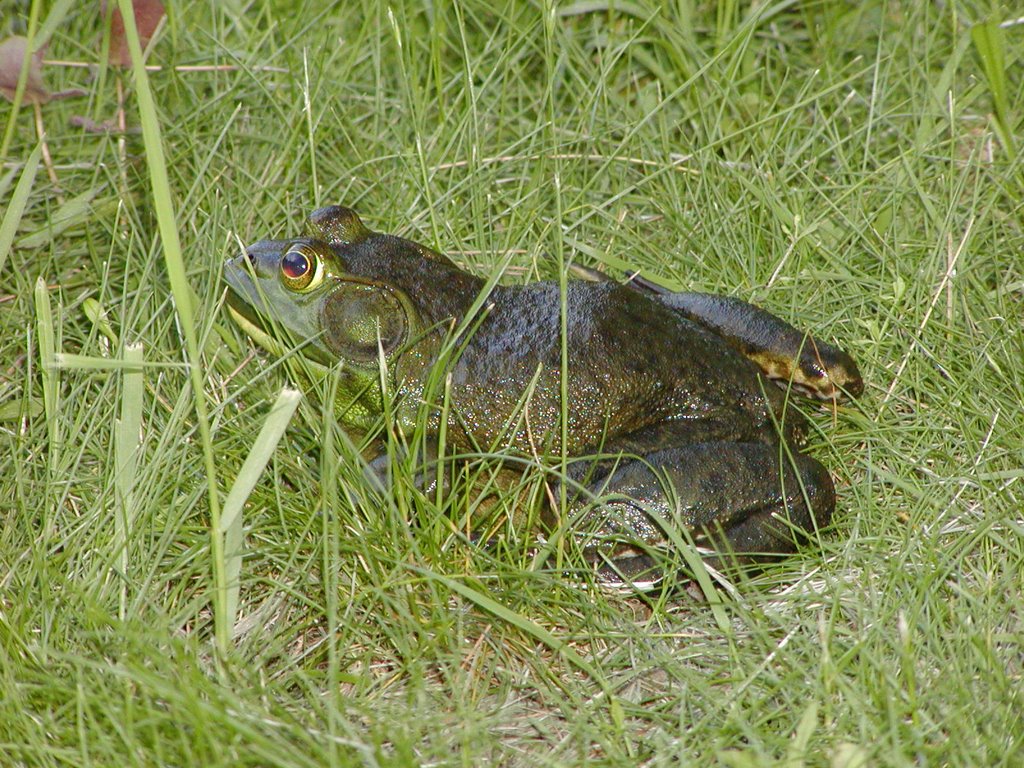
American Bull Frog

I continue to educate my 4 year old daughter on the wildlife in and around our area. Yesterday our adventures continued with the catching of one of my favorites, the Bullfrog.
The bullfrog brings up many fond memories of my childhood, of a time when these types of amphibians were more common and I didn't know what true responsibilities were. Summers visiting and vacationing on Sebago Lake's Frye Island. We wouldn't have been to the cottage for very long before I'd race down to the swamps in search of some type of critter - snakes, toads or frogs. Bullfrogs were the more common and most fun and I almost always ended up bring one or more back to the cottage to spend the time with.
We were fortunate to come across a bullfrog yesterday while visiting my mom. This frog was kind enough to let me catch him so that my daughter could get a first hand, up close look and feel and yes, even a kiss... Up until this point my daughter had only seen and held tiny frogs and toads but this critter put the name "bull" in bullfrog. This guy was even kind enough to "cry" for us. I don't suspect many people have heard a bullfrog cry, and that's too bad, it's a sight and sound to behold.
Internet Bullfrog reference
Friday, June 09, 2006
Eastern Snapping Turtle (Chelydra Serpentina)
I came across this turtle in the middle of the road the other day. This is a female Eastern Snapping Turtle (Chelydra Serpentina) -The day before my dad had brought home an Eastern Painted Turtle he found crossing the road. I thought it would be a good learning experience and contrast to bring this girl home too and introduce her to my daughter - she's 4. I also wanted to ensure that this critter didn't become a road kill casualty, as so many do this time of year.
She proved to be a VERY aggressive girl. The following morning we took some pictures then hoped in the truck and took both turtles to a nearby pond, where we released them. Hopefully they're happy and enjoying there new home...
*** Update, June 13, 2006 - I caught another snapping turtle this past weekend. This girl was larger than the one pictured above. She too was attempting to cross the road. I tried to get her turned and headed away from the road but she refused. At that point I decided it best to not chance her attempting to cross after I'd left so I took her with me. We took some pictures of her and this time I measured her shell - 13" front to back and 10" wide, then off to the pond for her release.
The following information was obtained from the Internet -
The Eastern Snapping Turtle is the largest freshwater turtle in Massachusetts. Snapping Turtles are distinctive and ancient-looking turtles that can be as large as 20” and weigh up to 35 pounds, although some individuals are even larger. Males are much larger than females in this species. The carapace of a Snapping Turtle is serrated at its posterior margin and may have keels on the dorsal scutes. The tail is long and “saw–toothed” and the head is large with a hard beak.The shell is usually dark green to black and is sometimes covered with algae. The skin is usually brown, black or tan. The legs are large and heavily scaled and the feet are webbed with long claws.
The Eastern Snapping Turtle ranges from the eastern United states and southern Canada southward to the Gulf of Mexico and west to the Rocky Mountains and can be found in most permanent or semipermanent bodies of fresh or brackish water, including rivers, streams, pools, bogs, legs, lakes, and marshes. The Eastern Snapping Turtle frequents well-vegetated wetlands with soft muddy banks or bottoms and is almost entirely aquatic.
Snapping Turtles are omnivores, feeding on fish (bullheads, sunfish, perch), aquatic invertebrates, crayfish, live vertebrates, carrion, and plant material. They are highly herbivorous and can be seen “grazing” on cattail roots (Typha) and water lilies (Nymphaea).
The Snapping Turtle reaches sexual maturity between 5 and 7 years of age. They typically lay eggs in soil, lawns, fields, and leaf or twig piles and deposit between 11 and 83 eggs in one or two clutches per year. Snapping Turtle eggs usually hatch after 2+ months of incubation, usually in early September.
Mom, I Miss You - Sweet Dreams...
Tuesday, June 06, 2006
Vlad's Suggestions
I will update this list as new recommendation come in, so return frequently because you don't want to miss a thing -
**** Items highlighted in green have been tried, completed, read etc
*** Update, June 9, 2006 - This just in...Vlad has refused to provide additional recommendations UNTIL I have acted upon, at least, one of his suggestions below. I was simply asking him for a nice wine recommendation and WHAM he hits me with this ultimatum. Arguably I agreed with him, so off to the book store I go to pick up "The Name of the Rose", afterall I refuse to eat Duck Liver Pate...
*** Update, June 13, 2006 - Well I made it to the book store Friday night and picked up two books - "The Loved One" and "The Name of the Rose". I hope to begin reading The Loved One soon.
*** Update, June 23, 2006 - Tried Gazpacho at lunch today - it's not too bad. I am not a big fan of vegatables in general, therefore since Gazpacho is made from fresh vegetables I didn't enjoy completely. However, the juice was tasty and reminded me of what my mother would call "butta butta", which I believe is Greek for dipping.
*** Update, June 24, 2006 - When Vlad and I made our WholeFood run on Friday to pickup the Gazpacho, I also picked up two Iggy's bagels - one plain and one multigrain. I had the multigrain one this morning toasted with butter - very, very good and tasty bagel! Typically bagels with toping almost alway loose their toping in the process of slicing toasting and buttering but this bagel held onto the majority of it topings.
*** Update, June 25, 2006 - Purchased a six-pack of "Old Speckled Hen" ale today and gave one a try - I enjoyed it, However, very expensive, as I paid $8.50ish for a six-pack...
*** Update, July 3, 2006 - At Vlad's request the "Cîroc® Vodka" needs to be removed from his list of recommendations below. Although this vodka came highly rated by Vlad origionally it has tumbled and it no longer a favorite. Too fruity a taste, which is too overwhelming when consuming this vodka in the quantities that Vlad drinks.
*** Update, July 20, 2006 - Today I tried Salmon caviar. It was meticulously prepared by Vlad himself on a piece of dark bread with plenty of butter. However, there's a bit of a discrepency with this 'tasting'. Apparently, Vlad doesn't believe it was a true tasting because there was "not enough quantity"...go figure.
*** Update, July 31, 2006 - We purchased from eBay, "Everything You Always Wanted To Know About Sex But Were Afraid To Ask". We just have to find the time to watch it...it's on the 'list'!
- Woody Allen film - "Everything You Always Wanted To Know About Sex But Were Afraid To Ask" - starring: Woody Allen, Tony Randall, Lynn Redgrave, Gene Wilder & Burt Reynolds
- Black Cat White Cat (1999) - starring: Bajram Severdzan and Srdjan Todo
**** Foods ****
- Iggy's Bagel - "Iggy's Bread of the World" is at 130 Fawcett St., Cambridge, 617-491-7600. Iggy's bagels are sold at many Whole Foods Markets
- Duck Liver Pate with Truffels...I'll be passing on this one, YUK!
- Avocado - Cut in half, add salt, use spoon to scoop and eat.
- Gazpacho - A Spanish-style soup that resembles a sort of chunky liquid salad, with lots of fresh, uncooked vegetables suspended in a broth of pureed tomatoes or tomato juice and chicken stock.
- Pelmini - Are a national Eastern European (mainly Russian) dish - usually made with minced meat filling, wrapped in thin dough (made out of flour and eggs, sometimes with milk or water added). Pork, lamb, beef or any other kind of meat can be used as a filling and mixing several kinds is popular. Pelmeni belong to the family of dumplings.
- Caviar (Salmon) - Caviar
**** Wine/Beer/Liquor ****
- Old Speckled Hen - A most gratifying Ale.
- Cîroc® -Vodka distilled from fine French grapes.
- Matua Marlborough Sauvignon Blanc - A distinctive and aromatic Marlborough sauvignon blanc, delivering bright and lively gooseberry and passionfruit characters with a hint of lime. Produced by Matua Valley Wines in West Auckland, New Zealand.
**** Books/Readings/Author's ****
- Haiku
- Evelyn Waugh - "The Loved One", "A Handful of Dust", "Put Our More Flags"
- Umberto Eco - "Granita", "Misreadings", "The Name of The Rose"
- Vladimir Nabokov - "Lolita
- Gabriel GarcÃa Márquez - "One Hundred Years of Solitude"
- Paulo Coelho's
- His Divine Grace A.C. Bhaktivedanta SwamiPrabhupada - "Bhagavad Gita"
- Charles Bukowski - "The Most Beautiful Woman in Town and other short stories"
**** Miscellaneous ****
- Netflix - Netflix link
- Google Earth - Google Earth link
- FAST LANE - The Massachusetts Turnpike Authority's Electronic Toll Collection Program. FAST LANE is also operational anywhere E-ZPass is accepted.