Showing posts with label katydid. Show all posts

Tuesday, October 28, 2025

The Katydids By Golly!

When we were in Tennessee a couple weeks ago, we drove up onto our property to have a look around and check out the views, AND we were NOT disappointed.

The land had yet to be hayed and was quite a bit overgrown, which makes it an idle place for all sorts of critters but NOT for us walking. Oodles of grasshoppers and many opted to hitch a ride with us too.

I wish I had taken more pics to capture some of the other varieties but these are the only ones I snapped but how fortuitous was I to capture a male and female of the same family?!

Turns out these are NOT true grasshoppers at all!  Rather, these are Short-winged Meadow Katydids and a member of Tettigoniidae, which is the family for long-horned grasshoppers and katydids, that are distinguished by their long, thread-like antennae.

Female - 

Male -

The hind leg of the female, that she seemingly dropped off herself when I attempted to pinch her back legs together in an effort to pick her up to take a different angle pic, OUCH -

Something I just learned from the Google machine - "Insects can only regrow limbs during their nymph stage, before their final molt into adulthood. Once they become adults, their ability to regenerate limbs is gone, and any lost appendages are permanent."


Oops, SO sorry!

I've named her Eileen (I lean), hehehe

Wednesday, September 17, 2025

A Tettigoniidae Family Member

Seems I'm on an insect themed posting streak here recently, so I might as well continue...

I spied this female katydid, also known as a bush cricket or long-horned grasshopper, Sunday afternoon while out on my back deck. She was making her way up the downspout and onto the roof.  She was out a out a tad early, being they're nocturnal, but perhaps she was just making her way to wherever katydid gather in the evenings...


They're not a very speedy insect when crawling.  Kinda remind me of how a sloth seems to move in super slow-motion.

Even though the evening temperatures drop to the chilly side, these katydids are still a chorus singing away at night.  These dudes, along with the crickets, will lull you to sleep if you sit and listen to them long enough.

Saturday, July 27, 2024

Insect Camouflage

These Katydid's, also called Bush Crickets, blend in so well and are tough to spot, and perhaps they thought I didn't see them, but I did and snapped these pics!

This female is perched atop a seed pod from a spent Balloon flower -


This female is sitting on and dining on a grape leaf -


These dudettes are out there, along with SO many others, you just need to put the cell phone and spend some time outdoors and you'll be amazed at what you can spy.

Monday, October 28, 2013

A Stinky Katydid?!?

Here are a couple insects that have yet to stow away for the winter.  They were both hanging out on our back deck basking in the warm sun. They better get their tails in gear or there gonna find themselves out in the cold!
 
 
A Brown Stink Bug (Pentatomidae)

 
A Katydid (Tettigoniidae)

Friday, November 07, 2008

A Long-Horned Grasshopper

The family Tettigoniidae known in American English as katydids and in British English as bush-crickets, contains more than 6,400 species. They are also known as long-horned grasshoppers, although they are more closely related to crickets than to grasshoppers.

The katydid is named for its mating call, "Katydid! Katydidn't!''

This little lady was making her way across a window of ours, which is over top of the garage, so she was up there. I'm not sure how she was holding on and not falling, after all she's walking across glass. Also, you may have noticed that she's missing one of her hind legs. These critters are harmless and quite noisy during mating season but a calming, relaxing noisy. Oh and the chickens love em too...

Monday, October 01, 2007

Katydid 2007

Here are some pictures of a one-legged Katydid that we found hanging around on one of our kale plants. You can hear them carrying on all night long - I enjoy their songs but JoAnne not so much...


I'm holding the critter in the last picture. It's a pretty good close up picture and taken just before I tossed this dude into the chickens pen. There was quite the scuffle between Lucy and Ethel to see who was gonna get this tasty morsel. The good new is they both got a piece.

Thursday, October 12, 2006

Katydid

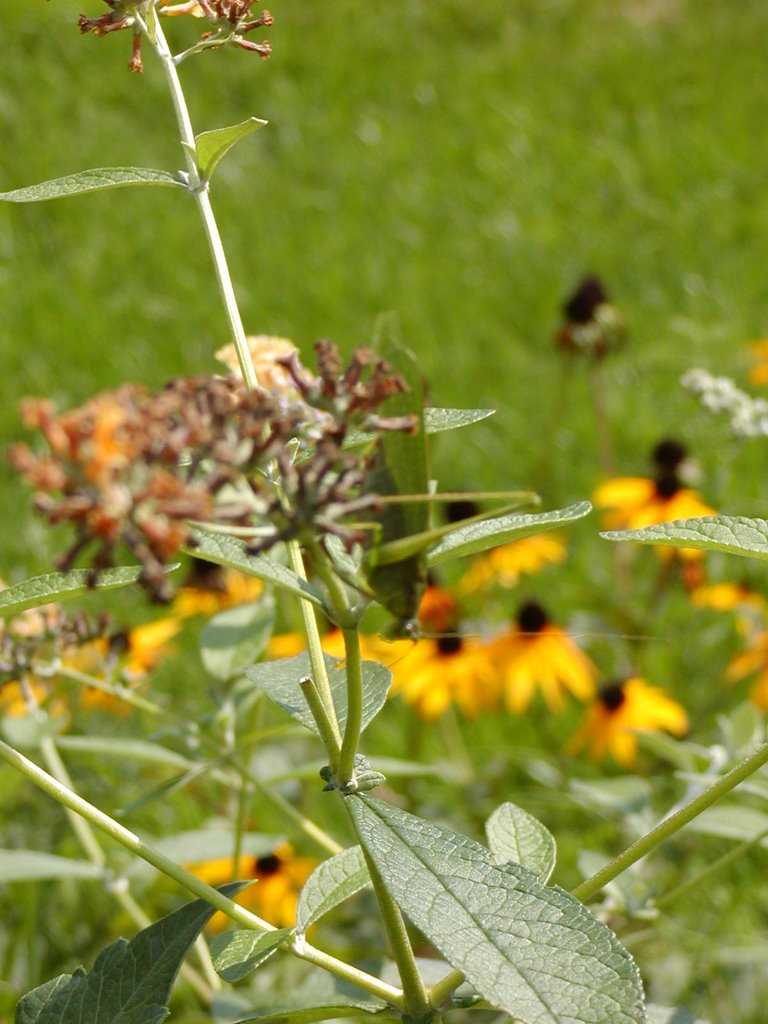
The pictures here are of a little guy we found hangin around our butterfly and dahlia garden. As you can see from the second picture he's one tough dude to spot. If you didn't know he was there you'd miss him 10 times out of 10 and you'd go hungry. Oh by the way, our dahlia's were fantastic this year, as you can see here!

KATYDID common name of certain large, singing, winged insects related to the grasshopper and cricket family (Tettigoniidae). Katydids are typically green or, occasionally, pink and range in size from 1 1/4 to 5 in. long. Katydids are nocturnal and arboreal; they sing in the evening. The males have song-producing, or stridulating, organs located on their front wings. The females chirp in response to the shrill song of the males, which supposedly sounds like "katy did, katy didn't," hence the name. The song serves a function in courtship, which occurs in late summer. The female lays eggs in the ground or in plant tissue; the eggs hatch in spring. Newly hatched katydids resemble the adults except for their smaller size and lack of wings. Katydids are common in the Eastern United States and are also found in the tropics.

There are some 4,000 species of katydids in the world. They feed on the leaves, stems, flowers and fruits of a variety of plants. They also form an important part of the diet of many animals higher up in the food chain.

The true katydids of Eastern North America are considered great singers; each species has its own repetitive song, which is produced only at night. Many species resemble leaves, which aid in there ability to hide from predators. They are powerful jumpers; many species do not fly but merely flutter their wings during leaps.


Do you see him?!

How bout now, anything?

Look closer. He's there; I wouldn't tease you like that...