Tuesday, January 09, 2007

Oh Deer

Here is a picture of a White-tailed Deer. This gal was visiting the neighbor’s backyard for a nibble of grass. She didn't stay too long once we saw her. I'm sure there were others close by we just didn't see them. This is the first deer sighting, from our window, for us this fall/winter.

I know they're out there a lot more then we see them, even in the summer. It doesn't take a Davy Crockett to see the signs; droppings, hoof prints, chewed plants etc. However, with the leaves off the trees and food scarce they tend to venture closer to houses with the cold weather.

We should discourage them from visiting and run them off when we see them just so they don't do damage to our shrubs, trees and plants but we do enjoy watching them when they come out.

Thursday, January 04, 2007

Vasilopita

Vasilopita - Greek New Year's Bread


The Vasilopita is a Greek New Year's Bread. It is made in honor of a beautiful act of charity by St. Basil to the poor and needy of his flock. In order to insure that the needy would have money for life's necessities, and knowing that the needy were also proud people, St. Basil had the ladies of his church bake sweet bread with coins baked into them. In this way he could give them money without demeaning them at all. It is therefore traditional to bake a coin into the Vasilopita (St. Basil's Bread). The one who receives the coin is considered to be especially blessed for the year.

Our family tradition is to gather on New Years Day, relax with family and have a nice dinner. After dinner the coffee is put on and the cutting of the Dime Cake begins. My mother always made the cake but with her passing JoAnne now makes it. My Uncle has been cutting the cake for as long as I can remember - since I was a little tyke, and still does it today. The first piece is cut for God, the second for the House and then from oldest to youngest. Although only one dime is baked in the cake my uncle keeps a pocket full of dimes handy and inserts them into the pieces of cake for the kids that are present. It is quite a site to see the kids face light up when they see they're piece has the dime! This is one family tradition that I hope to continue.

Click here for one iteration of the Vasilopita recipe

Wednesday, January 03, 2007

2006 Bill Chase Girls Hoilday Tournament

Horary! Yippee! Way-To-Go!!


My oldest daughter Stephanie's U14 ice hockey team won the 2006 Bill Chase Girls Holiday Tournament this past weekend.

They went 3-0-1 in the four games they played and took the championship with a commanding 4 - 0 trouncing of their opponent who they tied earlier in the tournament.

Stephanie's line scored all 4 goals, with Stephanie assisting of the first 2 in the championship game.

Colic

Good news everyone looks like I won't be suffering from Colic anytime soon since I've been taking Probiotics in my battle with Diverticulitis.

Initial reports indicate that Probiotic may cure Colic

Perhaps something good has come out of my consumption of prescription drugs these last 4 months...

Tuesday, December 26, 2006

Diverticulitis

Diverticulitis, I got it! I don't want it but I drew the short straw. However, it's going bye-bye come the first of the year - thanks to a little thing called surgery, along with approximately 1 to 1.5 feet of my colon.


I've been battling this disease since September 2006 - here it is December 2006 and currently on my 6th relapse, which occurs several days or so after I complete my cycle of antibioitics. I've taken several different types of antibiotic these last 4 months, anywhere from 7, to 10 to 13 days worth and in some relapse more than one type at a time - Ciprofloxacin, Metronidazole (known as Flagyl and NASTY!), Augmentin, Levofloxacin.

This last relaps landed me in the hospital for 4 days and 3 nights, which is my second stay in the hospital as a result of this disease. Although, diverticulitis was involved and did become irritated again the bigger problem was something the doctor's were referring to as "C-Diff" or Clostridium difficile colitis. Things appear to be under control at this point and I'm back on the Flagyl, as well as a Probiotic to help maintain the natural balance of organisms (microflora) in the intestines.

Since September I've had 4 cat scans, as well as a colonoscopy not to mention all the poking, prodding and needle sticks...Oh, almost forgot I had my prostate checked too, at least that's what the doctor told me. It felt like he was checking my tonsils... I've also become a regular in the emergency room. I am down 35lbs to 150lbs, which I haven't seen since my High School days, yikes! Also, in this time I have had to watch what I eat and have not been able to eat the things (junk) that I normally would - no alcohol, no pizza, no chips, no crackers, no nuttin good and I am not too happy about this, especially around the holiday's.

Keep your fingers crossed and hopefully the surgery will be a success and I will be on the road to recovery soon.

Here is some information on Diverticulitis from emedicine and some from WebMD -Diverticulitis
Shadows

My daughter Emilie and I at the beach.

This was taken at York Beach Maine in August/September of 2005.

Sunday, December 17, 2006

Piggy, Piggy, Piggy...


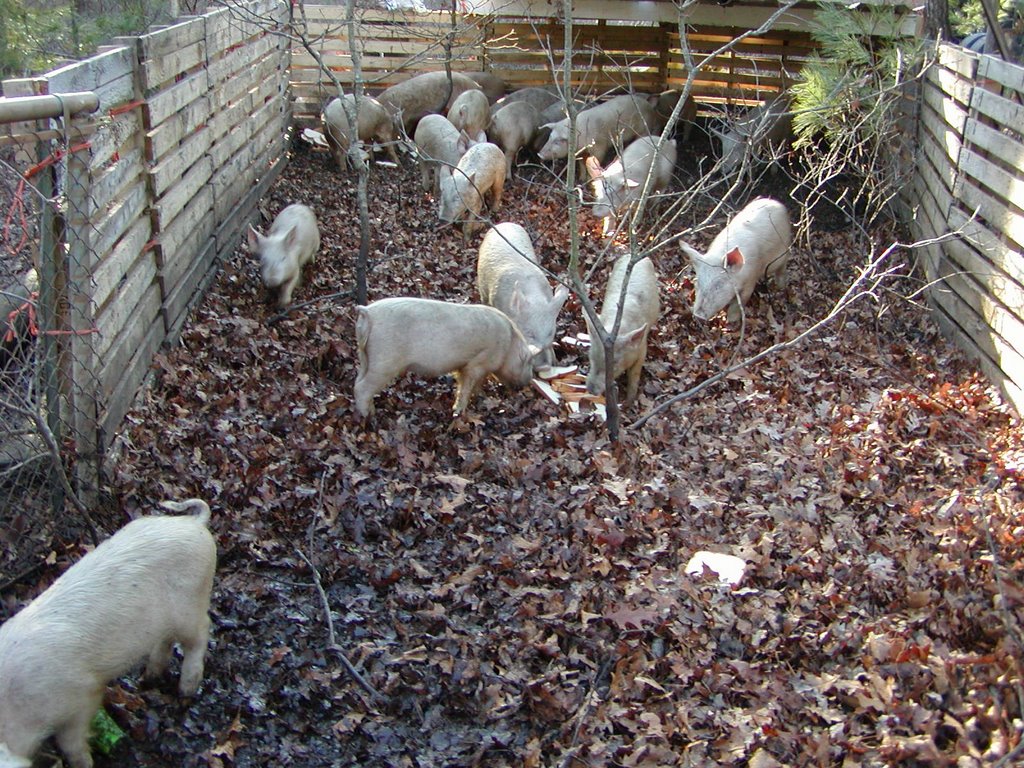
Here is a picture of the new piglets that my friend recently purchased. There are over 15 here but I was unable to get an exact count - you try to count them as they're darting in and out, climbing over each other and wrestling for food.

The males have already been 'fixed' and will go to market when they're at the right size. The females will stay and be bred when old enough to replenish the stock.

This is only one of 3 pig pens. The other 2 have adult pig; pigs that are well over 400lbs in size. The females in these pens are used for breeding and the males - except for the one lucky guy that's kept for breeding, will go to market. Many of the sows in these pens have already been bred and are due in early spring.

Saturday, December 16, 2006

LaMancha (Goats)


I took advantage of the unseasonable weather here in New England today and visited my farmer friend who lives on the south shore. It was in the mid 50's, which is unusual for this time of year. It has been awhile since I'd visited, so it was over due.

He's added a number of new animals to his menagerie since I last visited; beautiful show chickens (bantams) - some pairs and some trios, call ducks, 20+ pig - some new purchases and some from new litters and 3 female LaMancha goats (pictured).

As you can see from the picture these goats are unique in that they have no ears, which is a distinguishing feature. All three of these goats are pregnant and due in early spring. The picture shows three generations; the grandmother is on the right, her daughter in the center and her daughters daughter (granddaughter) on the left.

These three girls are extremely friendly, have a wonderful disposition and love to be involved with whatever your doing. They're already producing milk and need to be milked daily, which my friend is glad and eager to do. He enjoys the taste and say's you can't beat fresh goat milk, not to mention how good it is for you. We can't wait till the babies arrive, as they're sure to be adorable.

History of the LaMancha Dairy Goat


Monday, December 11, 2006

Spotted Salamander


Have a gander at what my dad came across just the other day! Keep in mind that it's December here in New England, so a find like this now is extremely unusual but let me clarify...

It's not that this little guy was on a walk-about. My dad was actually de-installing his sub pump from just outside the basement so it wouldn't freeze. The pump sits in a deep hole that was dug just underneath a grate and crushed stones. Well, this guy had chosen this same place to hibernate for the long, cold winter. Perhaps he was drawn to the cold, dark and damp hole. I didn't want to handle him, so I didn't measure him but I would guess he was close to 7" long.

My dad kept him outside in a bucket, so not to wake him from his winter nap, until we were able to visit. Emilie was excited and refers to him as a lizard. We took a number of pictures before releasing. I placed him near the edge of the wood, under several planks of wood and covered him with some additional cold mulch. Hopefully this will suit him well and keep him safe until March when he'll awaken and make his way to the vernal pool next door for some nookie!!

My dad finding this guy is reassuring to know that they're still out there and doing fine. It also brings back some good memories of when I was young. Come the first full moon in March, ideally on a raining night, we'd put on our rubber boots, grab a flash light and head to the swap in the hopes of finding and seeing these guys on their migration.

I think I will introduce Emilie to this come March 2007.

Thursday, December 07, 2006

It's Begining To Look A Lot Like Christmas

Hereeeeeeee's the family Christmas tree!


JoAnne and Emilie did an awsome job setting up and decorating the ole family Christmas tree - wouldn't you all agree? Just waiting to be loaded with present...

Emilie's at that age now where she is completely taken by Christmas and all that goes with it. It gives me a renewed appreciation of how special this time of the year really is and just how lucky and fortunate a person (boyfriend, father & son) I am.

MERRY CHRISTMAS!!!

Wednesday, December 06, 2006

Jack-O-Lantern 2006

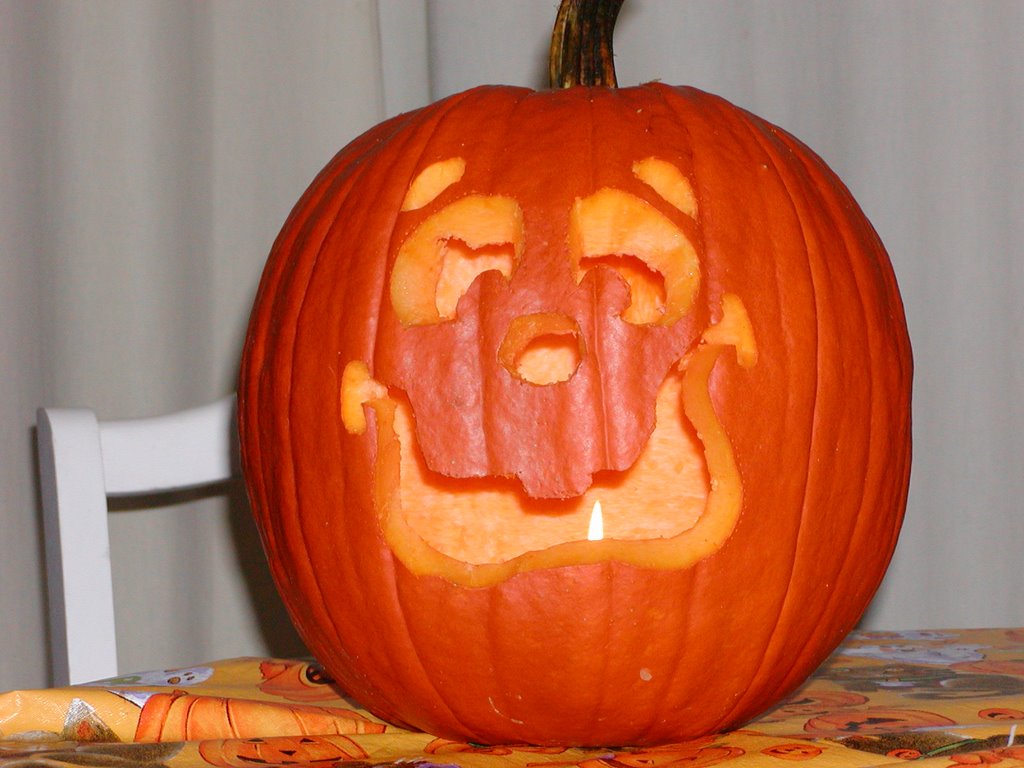
Although Halloween 2006 has come and gone, I thought I'd post a couple pictures of JoAnne's handy, carving work. She did this free hand and completely blindfolded, so you know that I watch my P's and Q's and that I am always on best behavior!

Day
Night

You're a peach Hon!

Friday, December 01, 2006

Woolly Bear Caterpillar


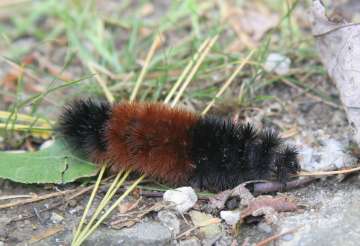
I was out in the yard on Thanksgiving morning cleaning out the chicken coop - well it's not really a coop just yet, more like a pen but it needed cleaning regardless so let's not split hairs here OK? Anyway, as I was pitch-forking the bedding out I came across a nice fat Woolly Bear caterpillar. We'd seen a number of them as the fall approached but never this late in the year. I guess the mild New England weather has kept these dudes, as well as other insects and critters, on the move and from going into a full hibernation.

I scooped this dude up and placed him in my jacket pocket for safe keeping and not to lose him - I didn't squish him either AND I actually remembered he was there too! Anyway, as I typically do, this dude was going to Emilie. Let me tell you Emilie eye's lit up when she saw him and screamed, "a woolly bear". She was in her glory with this critter. He was relegated to a Winnie the Pooh dixie cup for several days, which was it's safe haven from when Emilie wasn't holding him and playing with and making him do tricks, stunts etc. She came to us with the boot from one of her dolls - a 'hootchy mama' boot if you will. You know the long, knee high black boots...anyway guess where the woolly bear was 'stuck'?!?! Between you and me he wasn't stuck, he simply found a safe place to stay hidden. Eventually he made his way out and Emilie was once again in her glory. We let him go just the other day, much to his relief and looking forward to finding a safe place to winter.

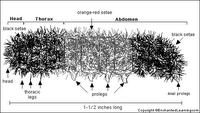
Woolly bears caterpillars were thought to predict how a coming winter was going to be. According to legend, the wider that middle brown section is (i.e., the more brown segments there are), the milder the coming winter will be. Conversely, a narrow brown band is said to predict a harsh winter. But most scientists discount the folklore of woolly bear predictions as just that, folklore.

Friday, November 10, 2006

Roof Moss?!

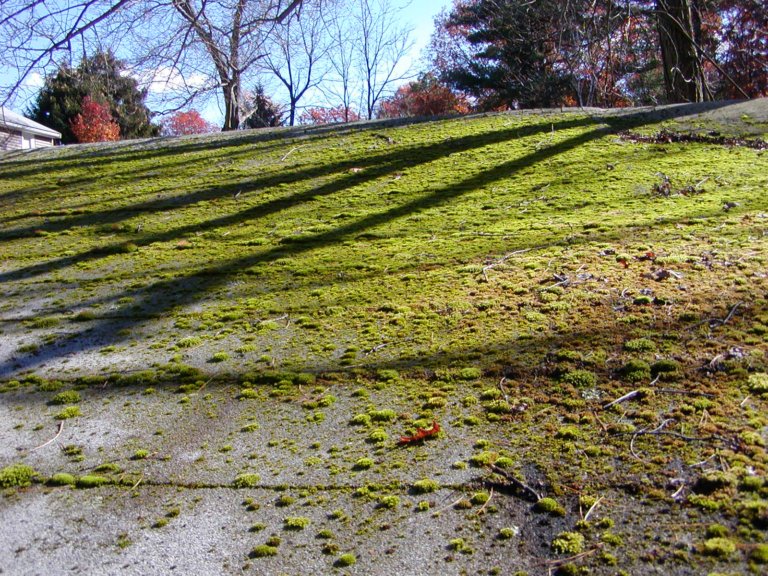
Here are a couple interesting pictures of moss growing on a shed roof...


I was at my dad's house the past Saturday to get his yard cleaned up and put to bed for the winter. The grass needed one last cutting but before that could happen the leaves needed to be picked up, the flower pots needed to be emptied and put away, frost killed annuals needed to be pulled and the gutters needed to be cleaned on both the house and the shed.

I used my 38" lawn sweeper to pick up as many leaves as possible. Although this is a valuable tool, it fills up too quickly with leaves and it did just that time and time again. I must have emptied that over 30 times! Once I had the majority of the leaves up it was then time to use the mower and bag the remaining ones. Once again, the leaves filled the mower bag too quickly and needed to be emptied over and over and over. Anyway, I am happy to say that the majority of the leaves, at that time anyway, were picked up and the grass cut nice and low.

I then moved to cleaning the gutters. I use a hand-held Craftsman leaf blower for this task - it works GREAT! The house gutters were not too bad at all - there are no large trees close to the house so their leaves have little effect. However, the shed roof is a different story, as it sits beneath several tall maples. Needless to say it doesn't take too long for the gutters to fill and become clogged.

Well, as I climbed the ladder to get on the roof I was amazed to see the back of the roof, which is not visible from the house and day to day activity, was covered with moss! It looked like the roof was covered with a nice green carpet. This is NOT a good thing to have happening, not at all. The moss retains moisture, which does damage to the shingles, as well as the added weight. We need to understand the cause of this so we can prevent it from happening again but we also need to figure out a way to kill the moss and remove it. I used a snow shovel and was able to scrap off and remove some but most remains. I am thinking of spraying a water and bleach solution on it to kill the moss...just an idea, we'll see.

Anyway, the gutters have been cleaned and the yard put to bed - come on ole man winter!

P.S. These pictures were taken before I cleaned the roof and gutters. All the leaves, sticks and 'stuff' have been removed - it looks better. I do good work, after all why do something unless you're going to do it right, right!

Wednesday, November 01, 2006

Blue Bird

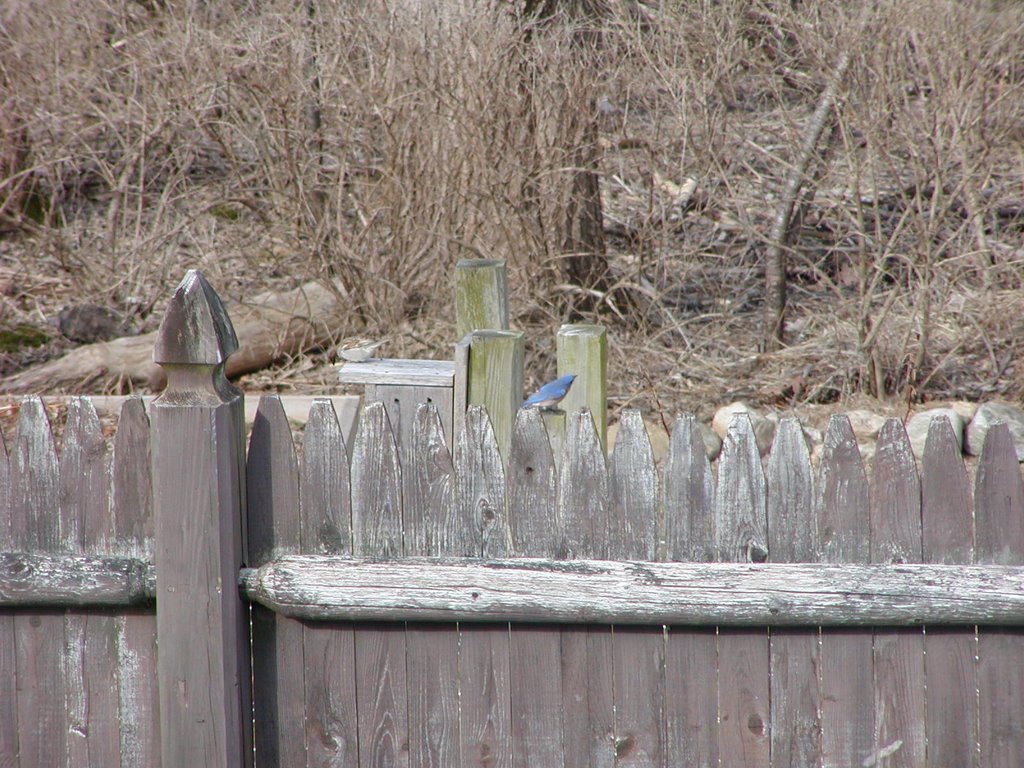
Yup, a Blue Bird!


This picture was taken in the early Spring. You can see him perched on the fence in our backyard. He didn't stay too long at all and honestly I am not sure how I was even able to take this picture of him but I did and here's the proof!

This magnificent little fellow dropped in and surprised the day-lights outta me. Although we live in what was once known as a farm type community that was a long time ago. As I imagine with most communities today construction is constant and the face of the towns are changing. As a result the open spaces are becoming harder to find, so it was VERY surprising to see this dude visiting our back yard. Needless to say I was pretty excited at this sighting. JoAnne was not as moved and didn't fully understand my excitement but played along just the same - she's a peach!

I was hoping he'd decide to choose one of our bird houses and stay but we only saw him that one time. Perhaps, he'll visit us again next Spring and hopefully stay longer. Time will tell...

Tuesday, October 31, 2006

Jack

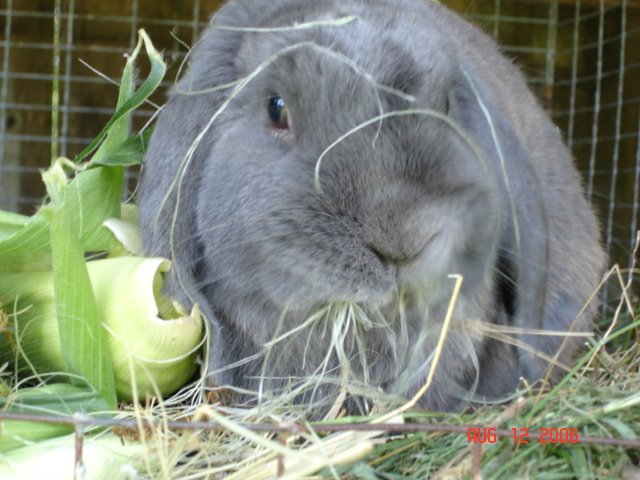
This is Jack.

Here he is enjoying a treat of corn cob silk. He and our other rabbits love the silk and the husks from the ears of corn - too bad this wasn't available year around in New England.


Jack is a handsome grey male (buck) Holland Lop rabbit. He was named by our daughter Emilie after a day care classmate of hers.

We bought Jack from a young kid a few towns over from us. We saw his, "Rabbits for Sale" sign at the end of his driveway and pulled in. We were in need of a Holland Lop buck, as our previous buck had passed away a couple months earlier. As fate (I guess) would have it he had only one Lop and it turned out to be a breeding age buck, Jack. It's funny how that stuff works...

We've had Jack now for about 18 months now. He has a great personality and a friendly disposition AND he knows his away around the bedroom, if you know what I mean wink, wink. He'll get to strut his stuff with the ladies come the first of the year, as we'll be breeding the doe's in preparation of Easter.

We now have 4 rabbits; Jack and three Holland Lop females (doe's). We just relocated all 4 from their outside cages to their inside cages in our garage. Although it's still chilly in the garage they're fine. The biggest concern with keeping rabbits outside during the winter is not necessarily the cold but rather the wind. With them being inside it's easier for us to take care of them and the get more attention and lovin.

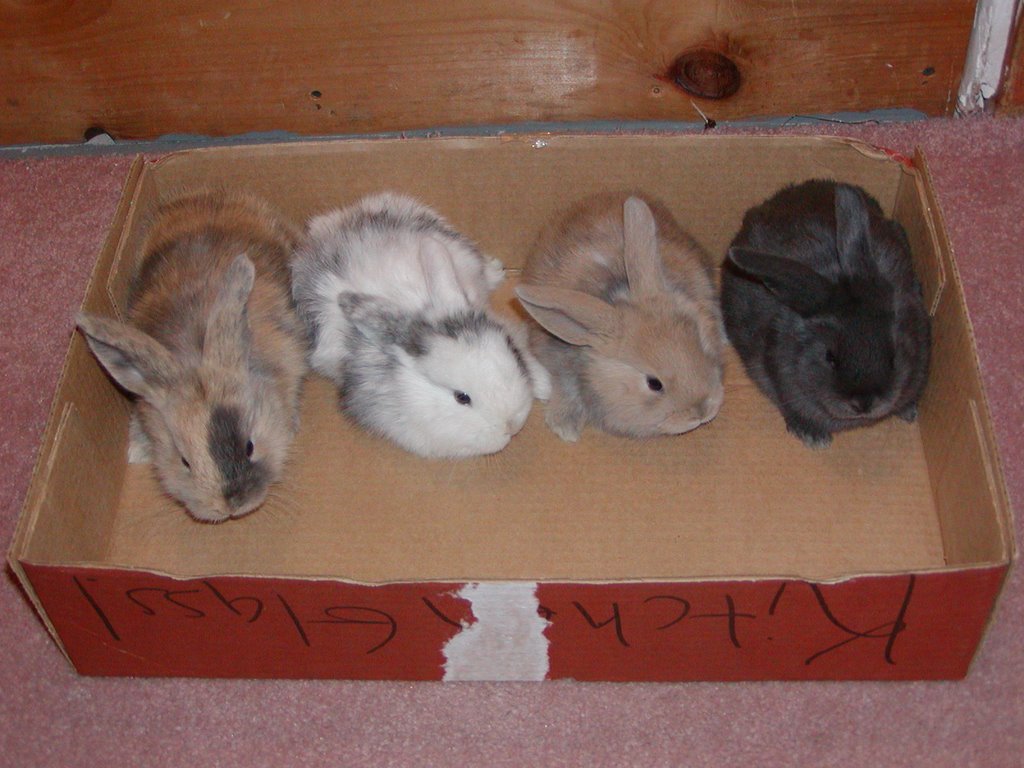
Here is a picture of Jack's babies from his first litter. These 4 adorable bunnies were born Tuesday, April 4, 2006. They all went to nice homes and are doing great today!

The American Rabbit Breeders Association, Inc. is loaded with a wealth of information on rabbits

Monday, October 23, 2006

Crackers

Meet Crackers

Here she is, being resourceful, on or actually in the bird bath getting a drink.

Crackers is a 16+ year old cat. She was one of two pairs of twins; one set siamese in color and markings and the other set all black. We kept her and found homes for the other three. One of the black kittens was taken by a close neighbor and is still alive today too. I don't recall who took the other two, so I am not sure if they're still alive.

She's an outside cat and very low maintenance. She isn't the friendliest and never has been more standoffish and skittish (she's no Doodle). She's a good cat too, as far as good cats go. Actually, I gotta admit I'm not really sure what a good cat is. Sadly, I saw one dead in the road (road kill) not too long ago and I was thinking, 'now that's a good cat' but that's prolly a mean thing.

Her mother was a good cat - no not the road kill kind! Booger was her name, not too lady like I admit... She was named after Dudley 'Booger' Dawson (Curtis Armstrong) a character in the movie Revenge of the Nerds. She was black with splashes of tan, yellow and white and had long hair but not too long. I found her at a local animal feed store and took her home - I don't remember how long ago that was but it's safe to say it well over 16 years. She was a kitten at the time and must have been around 2ish when she had her litter, so we're talking about 18 - 20 years ago, YIKES! She was an outside cat just like her daughter but she had a great personality and was always looking for lovin and attention. We don't know what happened to her, she just disappeared one day.

Thursday, October 12, 2006

Katydid

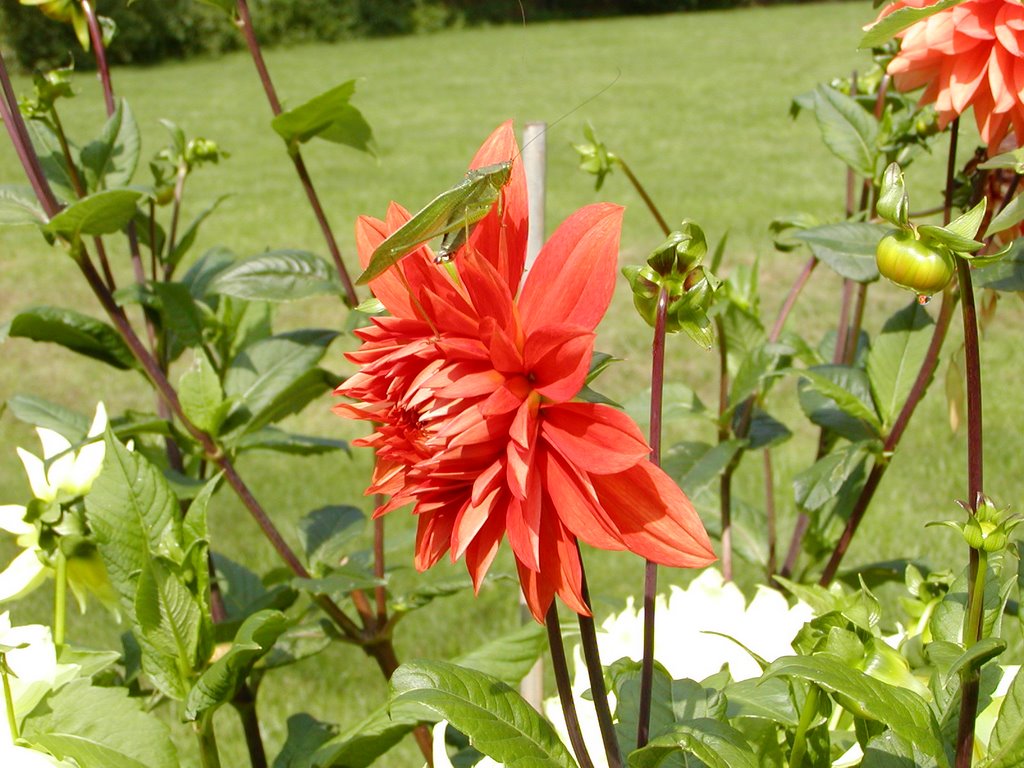
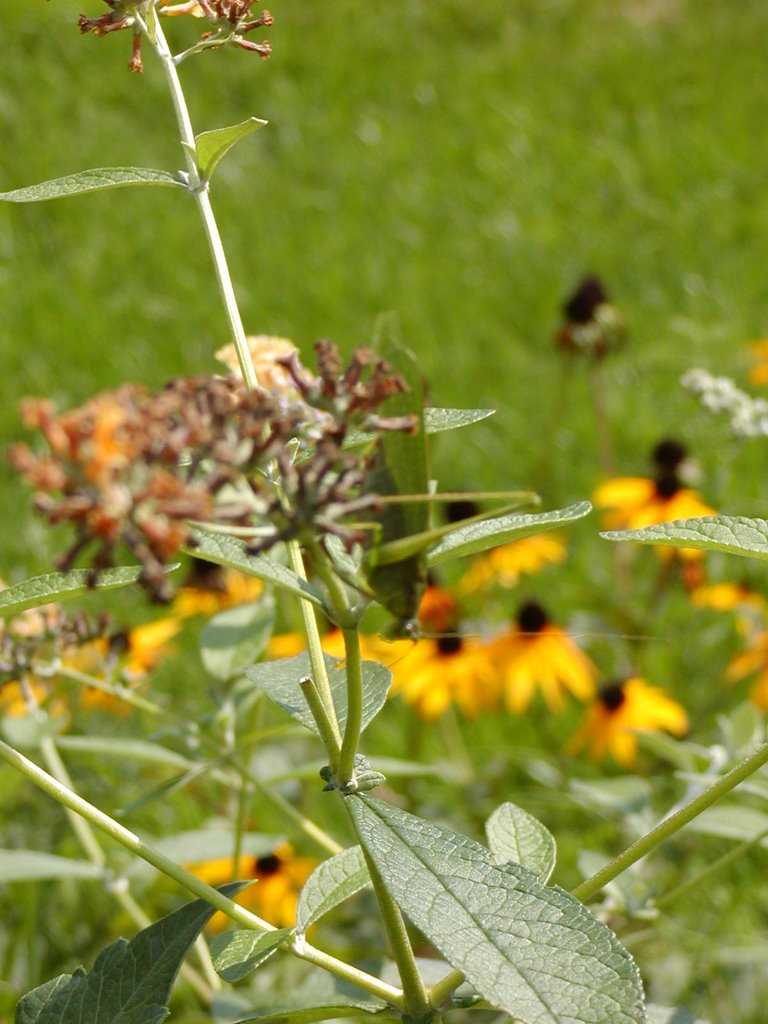
The pictures here are of a little guy we found hangin around our butterfly and dahlia garden. As you can see from the second picture he's one tough dude to spot. If you didn't know he was there you'd miss him 10 times out of 10 and you'd go hungry. Oh by the way, our dahlia's were fantastic this year, as you can see here!

KATYDID common name of certain large, singing, winged insects related to the grasshopper and cricket family (Tettigoniidae). Katydids are typically green or, occasionally, pink and range in size from 1 1/4 to 5 in. long. Katydids are nocturnal and arboreal; they sing in the evening. The males have song-producing, or stridulating, organs located on their front wings. The females chirp in response to the shrill song of the males, which supposedly sounds like "katy did, katy didn't," hence the name. The song serves a function in courtship, which occurs in late summer. The female lays eggs in the ground or in plant tissue; the eggs hatch in spring. Newly hatched katydids resemble the adults except for their smaller size and lack of wings. Katydids are common in the Eastern United States and are also found in the tropics.

There are some 4,000 species of katydids in the world. They feed on the leaves, stems, flowers and fruits of a variety of plants. They also form an important part of the diet of many animals higher up in the food chain.

The true katydids of Eastern North America are considered great singers; each species has its own repetitive song, which is produced only at night. Many species resemble leaves, which aid in there ability to hide from predators. They are powerful jumpers; many species do not fly but merely flutter their wings during leaps.


Do you see him?!

How bout now, anything?

Look closer. He's there; I wouldn't tease you like that...

Monday, October 09, 2006

Mr. Eastern American Toad

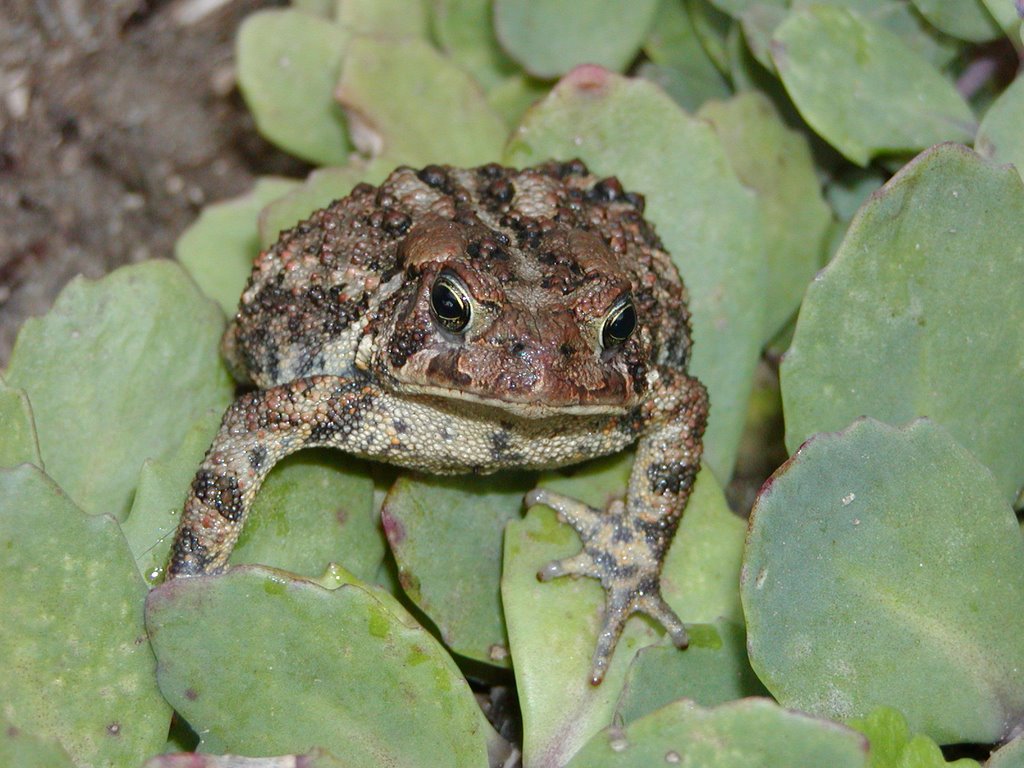
The Eastern American Toad ((B. a. americanus) is a common species of toad found throughout the eastern United States and Canada.


Here are a couple picture of one that I caught at work, during lunch just the other day. He spent the afternoon in my desk drawer, in a styrofoam cup until I got home. Once again, we kept her for the day and released her in the back yard. Here she is sitting on a Sedum plant. She had no problems posing for pictures, just look at her boasting full of confidence...

One of the benefits of having these amphibians hangin in your back yards is that they eat a variety of invertebrates, especially ants, beetles, slugs, spiders and mites. The eating of the 'slugs' is what I am most grateful of. We have too many slugs in our yard, more often found on my hosta plants and raspberries plants and a general nuisance causing more damage then good.


Some people call these common creatures "hop toads", and they do indeed move about in short hops rather than long leaps. Most toads are brown, but their colour can range from grey-brown to red-brown. Breeding males have a black throat and are smaller than females. Toads emerge from hibernation and fill the night air with long, trilling calls in May and June. Strings of 6 to 12 thousand eggs are laid in warm shallows; the small dark polliwogs develop rapidly and transform into miniature toads by September. Toads are among the last amphibians to hibernate each fall, and may be seen into late November.

Toads have a dry, "warty" skin. The "warts" are glands that contain a white sticky substance intended to turn away predators biting the toad. Handling toads will not cause warts in people. Some people say toads have the most "character" of all the amphibians. They are the most commonly seen frog in towns because they frequent backyard gardens and front lawns, often staying in one area all summer. Their hind feet have special small knobs for shoving soil aside so they gradually sink and bury themselves.

Friday, October 06, 2006

Abutilon (Ab yew til on)

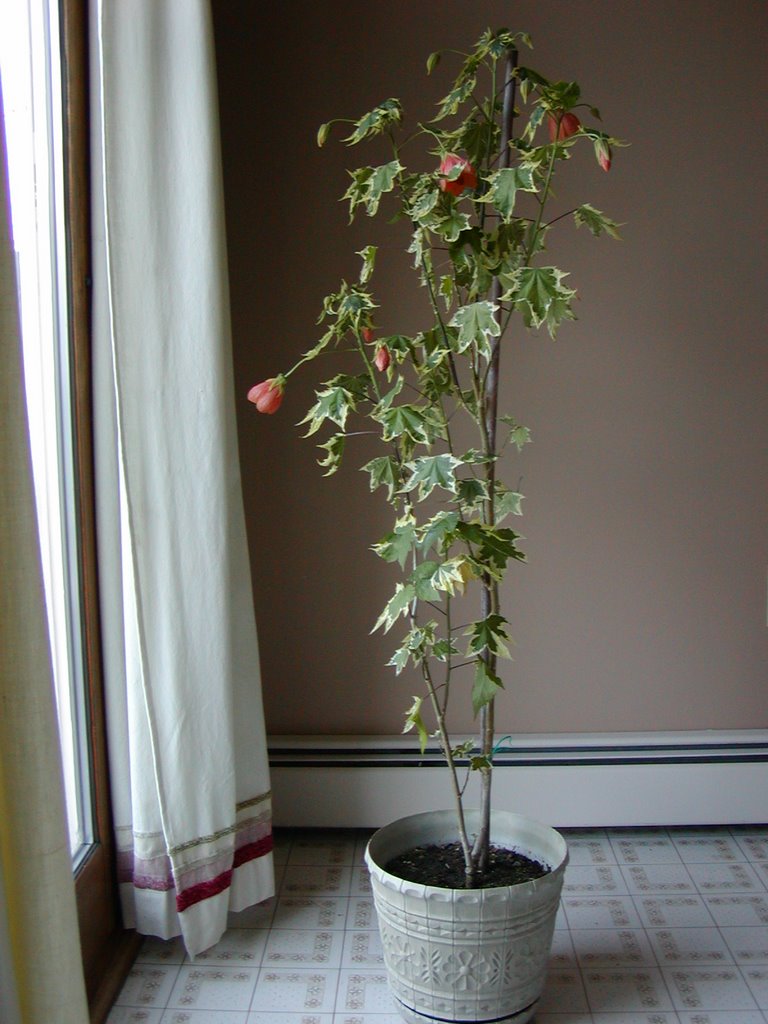
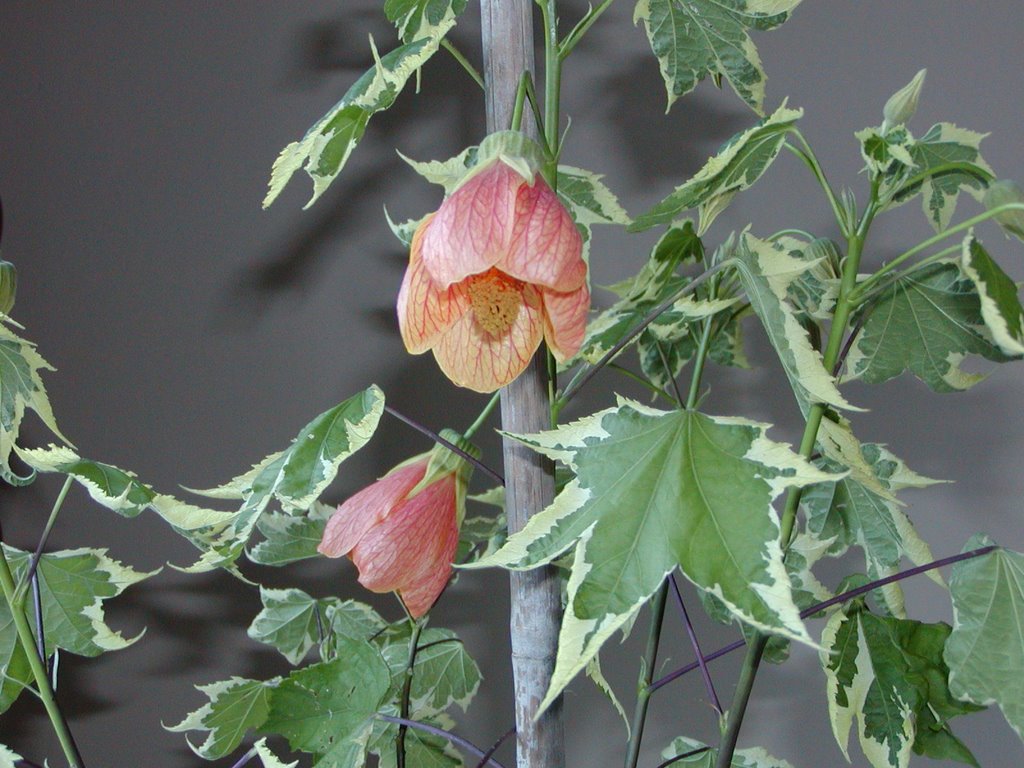
Here are a couple pictures of plant given to us from our farmer friend Tim called Abutilon. I believe this guy is a Parlor Maple 'Souvenir de Bonn'. Originally we over-wintered this plant, and one other, at our house last winter at the request of Tim. In the Spring he took one back to his place and gave us this guy. A year ago this plant was small, no more than 12 to 15 inches tall. However, once transplanted to a larger pot, some TLC and the Summer spent outside by the pool has done wonders for this guy. It's now approximately 4+ feet tall and flowering like crazy! With the approaching cold weather, we've relocated this guy indoors to the kitchen where we can enjoy it and it us.


Abutilon is a genus of about 150 species and many more varieties, with common names like; Flowering Maple, Indian Mallow, Parlor Maple 'Souvenir de Bonn'. Flowering Maples are handsome tropical shrubs in the mallow family with large, maple-like leaves. They have a continuous display, April through November, of pendant, waxy, bell-shaped flowers. In climates with mild winters abutilons can become large shrubs, quickly growing to 4'-8' tall. They are excellent plants for containers, where they typically grow 3'-4' high. In colder climates they can be brought indoors for the winter. Abutilons are indispensable for attracting hummingbirds. In areas with hot summers abutilons require some shade and regular watering.


Abutilon pictum 'Souvenir de Bonn' has pretty orange flowers, but the main feature of this variety is its cream-edged leaves. It is a vigorous, erect small tree to perhaps 10' in all dimensions. Typically evergreen, with all or nearly all the leaves showing the variegation. Flowers are pendant, bowl-shaped, and soft orange with green striations. 'Souvenir de Bonn' needs a zone 9 or 10 climate, or shelter indoors during the cold months. It does well in a pot when pruned back heavily.

Thursday, September 28, 2006